Self-confidence: you build it one step at a time
By HypnoSelf · updated November 16, 2026

Self-confidence is the feeling that you can handle what you set out to do. According to psychologist Albert Bandura, it grows mainly from what you’ve already achieved yourself. That suggests building it through small successes, with steps low enough to take one at a time.
In short
- Psychologist Albert Bandura (1977) calls the belief that you can accomplish a specific thing self-efficacy, and says it’s fed above all by your own past successes.
- Short-term goals can help confidence grow: in one experiment, children struggling with arithmetic progressed faster and felt more capable when encouraged to aim for six pages of exercises per session, rather than the whole 42-page program (Bandura and Schunk, 1981, 40 children).
- The HypnoSelf app starts with a conversation that pins down the belief holding you back. It then writes affirmations about your progress, which you hear each morning or evening in your own recorded voice.
| Key point | Value |
|---|---|
| Definition | believing you can handle a specific situation |
| What feeds it most | your own successes, even small ones (Bandura, 1977) |
| How to build it | short steps, taken one at a time (Bandura and Schunk, 1981) |
| What a lack of it looks like | holding back, feeling like an imposter, fearing failure or other people’s judgment, being hard on yourself |
Contents
What is self-confidence?
Self-confidence is the belief that you can handle a situation: making a decision, speaking in front of others, planning a project, trying something for the first time. It depends on the area: you can host twenty people without stress and still dread calling a stranger. It’s shaped by what you go through, so it can be rebuilt.
The American Psychological Association’s dictionary gives it two meanings: trusting your abilities and judgment, and believing you can meet the demands of a task. The second is close to what psychologist Albert Bandura called self-efficacy: “the conviction that one can successfully execute the behavior required to produce the outcomes.” He distinguished it from expecting the action to pay off. You can know a train goes to the coast without believing you could take it alone; according to Bandura, that doubt is what keeps you from acting.
Elsa is 41. In the spring, she and Ethan split up after twelve years together. All that time, he booked the tickets and found the vacation rentals; whenever they planned something, he’d say, “Leave it, I’ll take care of it.” One Sunday in October, her friend Claire, also separated, shows her photos of three days she spent alone at the beach. Elsa smiles: “I could never plan all that by myself.” Yet at the pharmacy where she works, she handles the orders without a second thought.
Elsa knows the train to the coast exists; what she doubts is whether she could take it alone. Her confidence is missing in this one area, and that’s where she can work on it.
Self-esteem is something else: what you think you’re worth as a person, overall. Elsa can see herself as a good person and still doubt she can read a train schedule with connections. A separate page explains how self-esteem differs from confidence and how it’s measured.
Where does self-confidence come from?
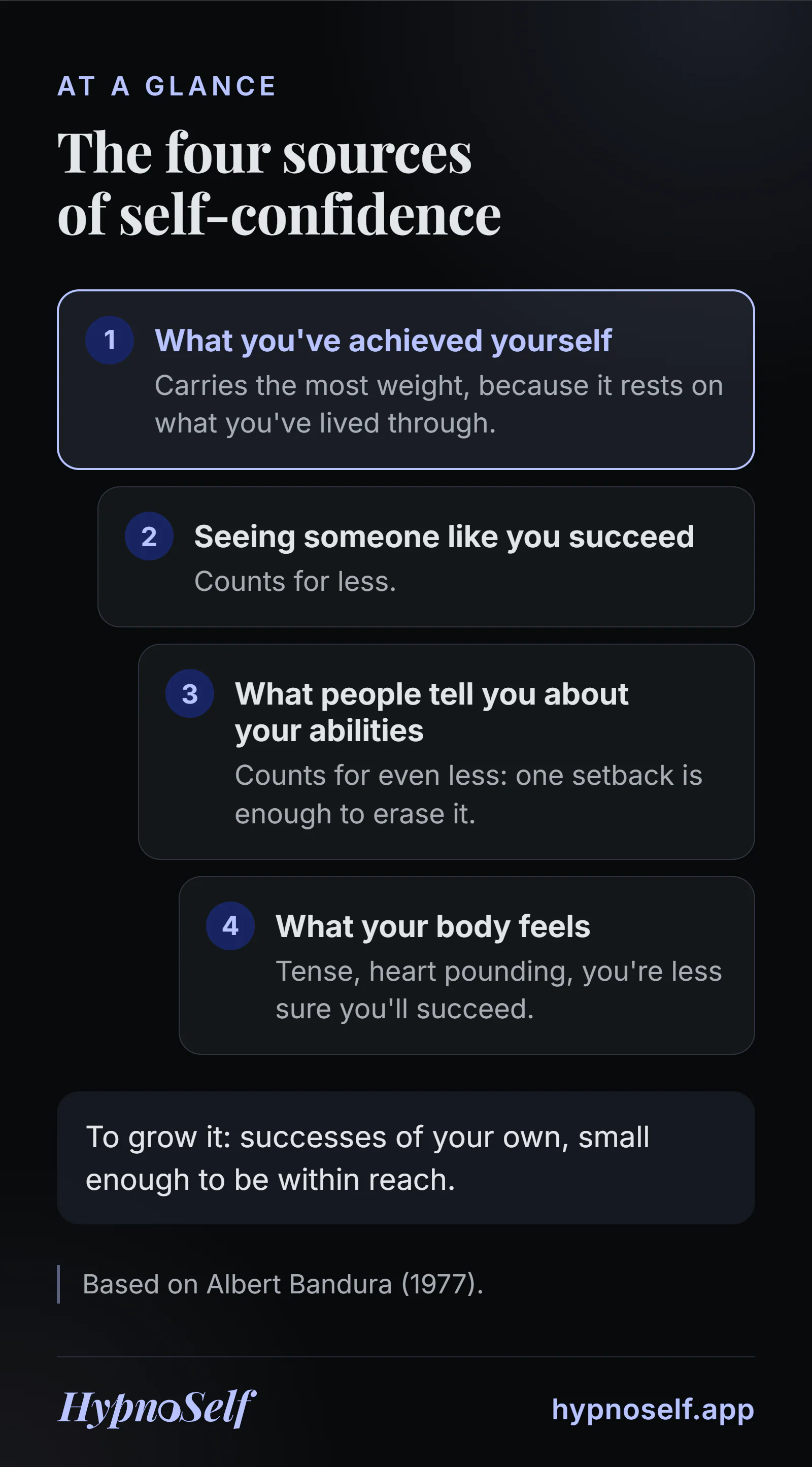
Psychologist Albert Bandura identifies four sources of confidence in your abilities: what you’ve achieved yourself, what you see people like you achieve, what you’re told about your abilities, and what your body feels when you face the task. Your own successes carry the most weight.
Bandura set out this idea in a 1977 theoretical article that became a classic (Bandura, 1977). The four sources don’t carry the same weight. Your own successes count most, because they rest on what you’ve actually done: repeated successes build confidence, repeated failures lower it, especially early on, and a single failure matters less once confidence is established. Watching someone else succeed counts for less. Encouragement counts for even less: with no experience behind it, one setback wipes it out. Finally, you judge yourself partly by how you feel: when you’re tense and your heart is pounding, you expect less of yourself.
| The source, according to Bandura | For Elsa, in October |
|---|---|
| What she has achieved herself | not one trip planned on her own in twelve years: nothing to build on |
| What she sees others achieve | Claire, also separated, went away alone |
| What she’s been told about her abilities | “Leave it, I’ll take care of it,” every time they planned something |
| What her body feels | a knot in her stomach just from opening the train schedule |
After a breakup, confidence can be missing where the other person used to do things for you: in those areas, the strongest source, your own successes, is empty. Ethan’s “Leave it, I’ll take care of it,” said kindly, ended up sounding like “You can’t do it.” For Elsa, Bandura’s ranking changes the approach: rather than advice or compliments, she needs successes of her own, small enough to be within reach.
Find your belief and reprogram it.
- You describe what holds you back
- The app writes your affirmations
- You record them in your voice
- You listen at bedtime
7 days free, no commitment
How do you build self-confidence?
To build self-confidence, or get it back, five exercises can help, most of them based on Bandura’s work: break your goal into short steps, take the first one and write it down, watch someone like you manage it, read your nerves without treating them as a verdict, then answer the sentence in your head that stops you.
1. Break what you want to try into short steps
Pick a specific situation and rate how capable you feel of handling it, from 0 (not at all capable) to 10 (completely capable). Then break it into three or four steps, starting with one you can take this week. It’s a gentle way to step out of your comfort zone without leaping into the unknown.
Why steps? Because in an experiment by two Stanford psychologists, a short-term goal got children further than a distant one (Bandura and Schunk, 1981). The 40 children, aged 7 to 10, had been picked out by their teachers for serious trouble with arithmetic and little interest in it. Each worked alone through a 42-page program of subtraction exercises, in 30-minute sessions. They were randomly assigned: some were encouraged to aim for a short-term goal, at least six pages per session; others a distant goal, all 42 pages in seven sessions; others had no goal; a last group didn’t do the program. After four sessions, the six-page children had completed 74% of the program, versus 55% with the distant goal. They solved more subtraction problems correctly and rated themselves more capable; later, given a choice between two activities, 90% went back to subtraction, versus about 40% in the other groups. The distant goal did no better than no goal at all. The experiment involved ten children per group and one school subject; for an adult, it’s an invitation to try the same thing.
For Elsa, the 42 pages are “going away alone for three days”: a goal so distant it gives her nothing to hold on to. The six pages are her steps. She rates her confidence 2 out of 10, then writes: “This week, book the ticket to the coast. In a month, one night alone in a city an hour away by train. In February, three days at the beach.”
2. Take the first step, then write down what you did
That same evening, write down in detail what you did yourself, and your new rating from 0 to 10. Your successes are the source Bandura ranks first; writing them down keeps you from brushing them off with “it was nothing.”

On Tuesday evening, Elsa compares train times, picks a train with a forty-minute connection, buys a flexible ticket for February and checks the date twice. She writes in her notebook: “Booked the ticket myself, connection and all.” Her rating goes from 2 to 4.
3. Watch someone like you manage it
Find someone close to you in age or situation who has done what you dread, and ask how they went about it, struggles included. According to Bandura, someone similar to you who struggled before succeeding is more convincing than someone for whom everything seems easy. Encouragement helps too, if it rests on a fact.
Elsa has Claire over for dinner. Claire tells her about the connection she missed on her first trip and the empty beach the next morning, then adds: “You handled your whole move by yourself in June. You’ll manage.” That move was a success Elsa had forgotten to count.
4. Read your nerves without treating them as a verdict
The night before a step that makes you nervous, notice what your body feels and name it: nerves, the normal reaction before something new. Your body’s reactions are one of Bandura’s four sources of confidence, and according to him, the way you read them matters a lot: by picturing yourself as incapable, you can work yourself into a fear far stronger than the situation itself would cause. Naming your nerves keeps a knot in your stomach from passing for proof that you’re “not cut out for this.”
The evening before her night away, as she packs her bag, Elsa’s heart is pounding: “See, you’re not cut out for this.” She corrects herself: “I’m nervous, like anyone trying something new.” The next day, she gets to the station twenty minutes early, finds her track, has dinner alone at a small Italian restaurant and comes home on Sunday. Her rating goes up to 6.
For one specific moment that worries you, like a speech, self-hypnosis for confidence offers another way to prepare: repeating encouraging sentences to yourself while relaxed, every evening, until the day you dread.
5. Answer the sentence holding you back with one about progress
Go back to your first rating and find the sentence about yourself that was pulling it down. Rather than its exact opposite, which would ring false, write a sentence about progress based on a step you’ve taken: it starts from what you’ve actually done, so you have fewer reasons to argue with it.
Behind Elsa’s 2 out of 10, one sentence keeps coming back: “I can’t manage on my own.” Its opposite, “I manage perfectly well on my own,” would make her laugh. “I’m learning to plan my trips, one step at a time” works, because the ticket and the night alone prove it. Worded this way, a positive affirmation is easier to believe, and it’s the form to use for affirmations for confidence. From your belief, the app drafts sentences about progress that you then record in your own voice.
What does a lack of self-confidence look like?
A lack of self-confidence takes several forms depending on the situation, each covered on its own page: not daring to get started, feeling like an imposter despite your successes, fearing failure, dreading other people’s judgment, or being hard on yourself after a mistake. Recognizing yours helps you choose where to start.
You don’t dare to get started
You keep putting off a sign-up or a request, month after month. A lack of self-confidence shows in everyday moments like these. It often starts with teasing or criticism you heard early on, at school or elsewhere, and avoidance keeps it going: as long as you don’t try anything, nothing ever proves the fear wrong. Its page describes the signs and causes, then suggests a first attempt, without planning a way to back out.
You credit your successes to luck
You get a promotion or a compliment, and you call it luck, dreading the day people realize it was all a mistake. Despite its name, imposter syndrome is not a medical condition. Here, confidence falters after the success, when it’s time to believe you earned it; the imposter syndrome page starts from the compliments you turn down and works back to the belief hidden behind them.
You’re afraid of failing
An exam to retake, a project to present: you keep pushing back the date. With the fear of failing, what frightens you often has less to do with falling short than with what would come after, like the shame of having to tell people. Its page sorts out these fears and suggests approaching what you dread one step at a time.
You worry about how others see you
Walking into a club where you don’t know anyone, asking a question in public: you feel eyes on you, and judgments along with them. The page on taming the fear of other people’s judgment starts from one observation: other people pay much less attention to us than we imagine. It suggests checking that impression in writing, before and after you go out.
You talk to yourself harshly
After a mistake, your inner voice treats you in a way you’d never treat anyone else. Psychologist Kristin Neff calls the opposite attitude self-compassion: giving yourself the kindness you’d offer a friend, without believing you’re perfect. Learning how to love yourself starts there, beginning with what you say to yourself the evening you forget something.
A lack of confidence can also take the form of shyness, an inferiority complex or a lack of motivation. Behind each of these forms, a sentence about yourself often comes back, like Elsa’s “I can’t manage on my own”: the HypnoSelf conversation looks for yours with you, one question at a time.
When is it time to see a therapist for self-confidence?
If self-doubt makes you give up whole parts of your life, or if anxiety never lets up, it’s better to talk about it: with a psychologist or therapist, you can get back on your feet at your own pace, and your doctor can tell you who to see.
HypnoSelf supports personal growth; it doesn’t replace help from a healthcare professional. If you’re going through a hard time, here’s who you can turn to.
Regaining self-confidence with HypnoSelf
One evening, after her night alone, Elsa tells the app about her trip, then about the twelve years of “Leave it, I’ll take care of it.” The AI assistant keeps asking questions, then rephrases what she’s said into one sentence: “I can’t manage on my own.” Elsa recognizes herself in it.
Elsa then receives 25 to 30 affirmations written by the app; several echo Bandura’s sources of confidence. “Elsa, you booked your ticket and spent a night alone away from home: you already know how to get organized” is encouragement, the source he considered fragile; because it leans on her own successes, the strongest source, it only asks her to recognize them. “Bit by bit, I’m getting used to organizing things on my own” describes a change that’s underway, without requiring her to have done it all already.
For twelve years, Elsa heard “Leave it, I’ll take care of it.” Now, each morning as she wakes up, before leaving for the pharmacy, her own recorded voice tells her what she knows how to do, a repetition meant to reach the subconscious. The idea of confidence coming back by degrees is an old one. Émile Coué, a French pharmacist famous in the United States in the 1920s, had the people who came to him close their eyes. He then told them, in the words of the 1922 English edition of his book, that “this self-distrust will disappear little by little and give place to self-confidence,” for anything “within reason, of course.”
When she leaves in February, Elsa would like to board her train to the coast without checking her ticket ten times.
Start the conversation. The conversation, your affirmations and your recording are free, no credit card needed. Listening then requires a card: it starts a 7-day free trial, cancel anytime before it ends, then a subscription.
Frequently asked questions
What does self-confidence mean?
Self-confidence means believing you can handle a situation or succeed at a task. Psychologist Albert Bandura uses the term self-efficacy for this belief. It varies from one area of life to another, and it grows mainly from the successes you’ve achieved yourself, even small ones.
Why is self-confidence important?
Self-confidence partly decides what you dare to take on. According to psychologist Albert Bandura, believing you’re capable determines whether you get started, how much effort you put in and how long you keep at it in the face of obstacles. Without it, you can know what to do and still give up.
How do you rebuild self-confidence after a breakup?
After a breakup, confidence may be missing mostly in areas your partner used to handle, like planning a trip or dealing with paperwork. It can come back through small successes in those areas, simple enough to achieve within a week. If the sadness lasts or gets in the way of daily life, a therapist can help.
How do I gain self-confidence quickly?
Self-confidence builds over time, but a first success can come as soon as this week: choose a step low enough to take, then write it down. According to psychologist Albert Bandura, the successes you achieve yourself are the most solid source of confidence, and they add up.
HypnoSelf is an app for affirmations written from your own words, recorded in your own voice and heard as you wake up and fall asleep. This page was written by the HypnoSelf team.