Repeating patterns: why they come back and how to break them
By HypnoSelf · updated November 14, 2026

A repeating pattern is a way of reacting or choosing that keeps coming back despite your resolutions: the same kind of partner, money that slips away as soon as it arrives, the same family argument. Research shows that a familiar situation ends up triggering the same reaction on its own. You can break it, starting from the belief that keeps replaying the scene.
In short
- A repeating pattern is the same story coming back with different people, in love, with money or in your family: a common experience, not a diagnosis.
- Research on habits shows it: a reaction repeated in the same situation ends up firing on its own, before you’ve decided anything (Wood and Rünger, 2016).
- In love, among 332 people followed in Germany, an ex and the next partner had similar personalities: having a “type” is real, and seems to come mostly from our own choices (Park and MacDonald, 2019).
- According to authors Joe Dispenza and Bruce Lipton, these reactions come from programs installed early, and a simple resolution carries little weight against them.
- HypnoSelf, an affirmation app, helps you find the belief behind your scene, then has you listen, at bedtime or when you wake up, to sentences written for you and recorded in your own voice.
| Key point | Value |
|---|---|
| What research shows | The same situation triggers the same reaction; in love, your next partner tends to resemble your last one a little |
| What the authors argue | Beliefs installed before age six or seven (Lipton, Braden) |
| Best time to listen | Bedtime and waking up (Murphy, Dispenza, Coué) |
Contents
Are you stuck in a repeating pattern?
If you think “here we go again” in a scene you already know, with different people each time, you’re probably caught in a repeating pattern. The telltale sign is how it unfolds: the same beginning, the same tipping point, the same ending, despite your promise to do it differently.
A few scenes many people recognize:
- In love: you fall for someone who’s “not looking for anything serious.” Three months later, you’re watching your phone, asking yourself, “Why does this always happen to me?”
- With money: you’ve barely put a little aside when it’s gone again, into a loan you couldn’t turn down or a purchase you “deserved.” A small voice concludes, “Money never stays with me.”
- In your family: you swore you’d never talk like your mom (or mum), and one tired evening, her words come out of your mouth, in her tone.
- With friends: you’re always the one who makes plans and listens; the day you’re struggling, nobody calls, and you think, “I matter less to them than they do to me.”
Three questions help you sort it out:
- Has it happened at least three times, with different people?
- Can you predict what comes next before it happens?
- Is the emotion stronger than the situation calls for?
If you answer yes to all three, it’s worth a closer look. Sometimes the cause lies elsewhere: an unfair boss or someone close to you who hurts you may be what keeps the scene coming back, and your way of thinking has nothing to do with it.
Why do I keep making the same mistakes?
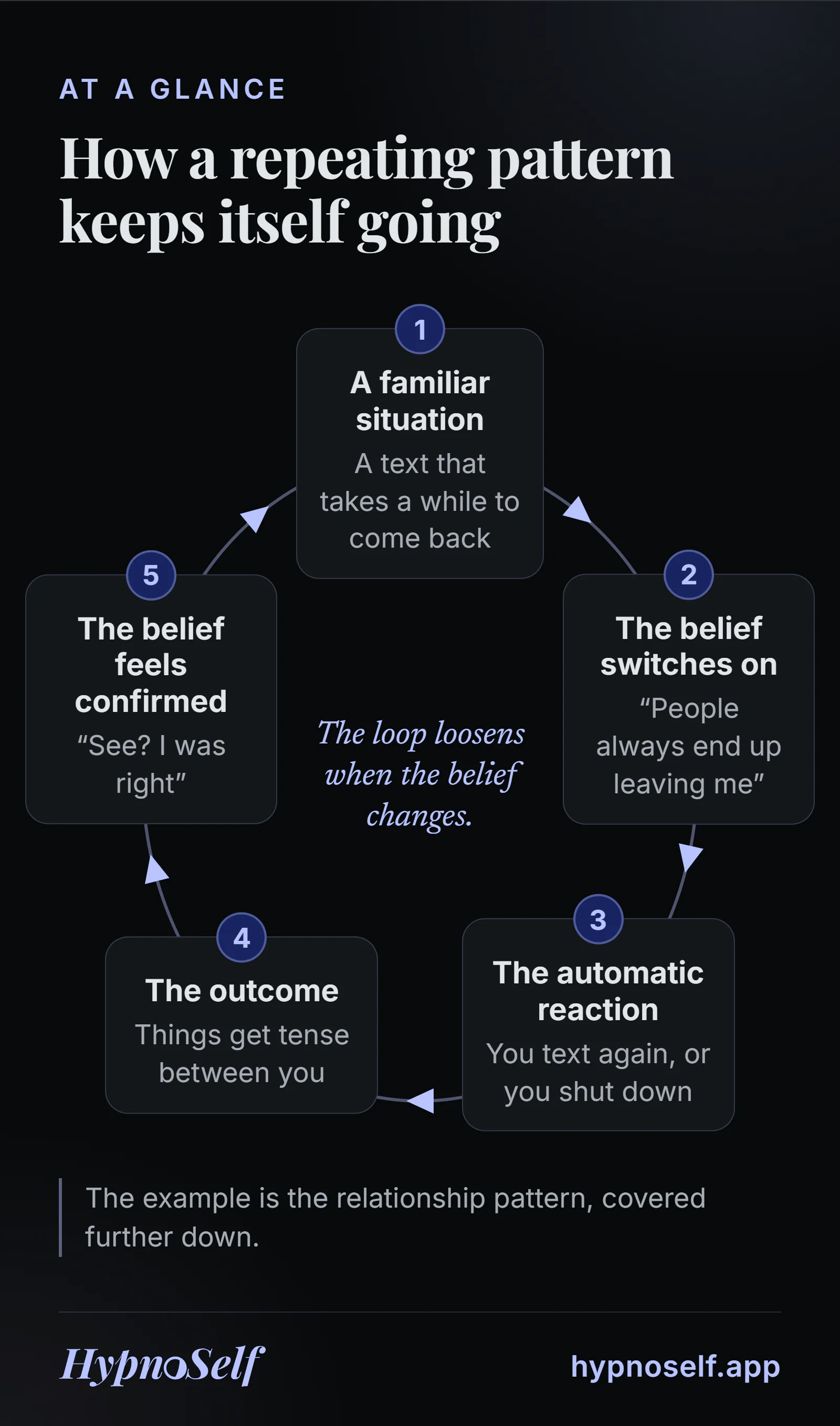
There are two reasons, and research has measured both. First, a reaction you repeat becomes a habit: the situation sets it off before you’ve decided anything. Second, without meaning to, you seek out whatever confirms how you see yourself, even when it hurts you. The two feed each other, which is why a good resolution isn’t enough.
Your reaction fires before you decide
Think back to the last time an important text went unanswered. Before you’d even thought about it, your stomach was in knots and your phone was in your hand. You didn’t decide to worry: it just happened, like the times before.
That’s what research on habits describes. In 2016, psychologists Wendy Wood and Dennis Rünger reviewed decades of studies (Wood and Rünger, 2016). When you often react the same way in the same situation, the two become fused: the situation alone triggers the reaction, faster than thought. And after enough repetitions, you come to believe you chose it.
An experiment co-authored by Wendy Wood shows how strong this link is (Neal and colleagues, 2011). Researchers handed moviegoers popcorn, either fresh or a week old and stale. People who always eat popcorn at the movies ate as much stale as fresh: their hand kept going to the bag on its own, even though it tasted bad. Seated in a meeting room instead, regular popcorn eaters left the stale popcorn alone: without the movie theater, the habit didn’t kick in.
A repeating pattern works the same way:
- The movie theater is the situation that comes back: a text that’s slow to arrive, a little money in your account, your mom’s tone on the phone.
- The stale popcorn is the reaction that does you harm: four texts sent in a row, the loan you agreed to when you couldn’t afford it, the argument.
- Like the moviegoers, you do it again knowing it’s bad for you, then find a reason for it: “that’s just how I am,” “that’s my type.”
The same team found reason for hope: when the moviegoers had to eat with their other hand, the habit broke, and they left the stale popcorn alone. Changing a single detail at the trigger moment helps you take back control: that’s the idea behind step 3, below.
What matches your self-image feels normal, even when it hurts
The second reason has to do with your self-image: without realizing it, you look for what confirms it.
Picture someone who believes, deep down, that they’re not worth much. Compliment them and they get suspicious, wondering what you want. Criticize them and it hurts, but it feels normal: the criticism fits what they believe about themselves; the compliment doesn’t.
Psychologists Kwang and Swann reviewed the experiments that pit two desires against each other: being seen in a good light, and being seen the way you see yourself (Kwang and Swann, 2010). Both count. But when rejection isn’t a threat, in a settled relationship for example, the second wins: people who think poorly of themselves prefer a view that confirms it to a compliment.
In a pattern, it looks like this: if you believe deep down that money isn’t meant for you, an empty account feels almost normal, and growing savings feel “not for you.” The situation that makes you suffer is also the one that feels like you, so you keep going back to it. It’s also why an overly flattering affirmation, like “I am rich,” rolls right off you, just like the compliment. This self-image often formed early: more on that under family patterns.
Why your resolutions aren’t enough
Against these two forces, a resolution carries little weight. Bruce Lipton’s example is the New Year’s resolution to eat less, forgotten the moment “the aroma of the baking turkey dissolved your resolve.” According to Joe Dispenza, when your willpower goes up against your automatic programs, “it only takes one stray thought or a single stimulus from the environment to turn on the automatic program again.” Say you’ve decided to stop lending money; a friend calls to ask for a loan, and the “yes” comes out on its own. That’s a program of your subconscious mind, faster than your willpower. So HypnoSelf works differently: the app starts from your own belief and has you listen to your sentences at bedtime and when you wake up. To begin, use the conversation to find the belief that keeps replaying your scene.
Find your belief and reprogram it.
- You describe what holds you back
- The app writes your affirmations
- You record them in your voice
- You listen at bedtime
7 days free, no commitment
What is repetition compulsion?
The idea isn’t new. In 1920, in Beyond the Pleasure Principle, Sigmund Freud described a repetition compulsion: some people relive the same painful scenes as if pursued by fate, with friendships that all end in betrayal or love affairs that each go through the same phases to the same end. Today, psychologists talk more about schemas.
According to psychologist Jeffrey Young, an early maladaptive schema is a stable set of memories, emotions, thoughts and beliefs about yourself and others, formed mostly in childhood or adolescence. Young describes 18 of them. His model is used in psychotherapy, and an online quiz can’t tell you which one is yours.
For Young, schemas grow out of childhood needs that went unmet: feeling safe, accepted, free to say what you feel. He also describes three ways of reacting to the same schema, which is why behaviors can look like opposites. Take the belief “I’m not good enough to be loved”:
- Surrender: you accept being treated badly, since you don’t expect any better.
- Avoidance: you pull away as soon as a relationship gets serious.
- Overcompensation: you go overboard to please, always available, always perfect.
A limiting belief, the sentence about yourself that holds you back, is the part of a schema you can put into words, which means you can work on it. It’s where HypnoSelf starts.
How do you stop making the same mistakes?
Breaking a repeating pattern takes five steps: spot the tipping point, find the sentence you tell yourself at that moment, plan a different reaction for it, repeat a believable sentence every day, and get support if it’s too much. To make them concrete, we’ll follow one example throughout: money that disappears every time you’ve saved a little, because a friend asks you for a loan and you don’t dare say no.
1. Write down the last three times
Write down the last three times the scene happened. For each: what happened just before, what you felt, what you did. For example: “Tuesday, I finally had $300 saved. A friend asked me for $200 to make it to payday. Just thinking about saying no made me feel guilty. I said yes right away.”
Side by side, the three scenes show what repeats, and above all the tipping point: here, the request for a loan.
2. Find the sentence you told yourself
Just before you react, a sentence crosses your mind, so fast you don’t notice it. Reread your three scenes and ask yourself, “What did I tell myself right before I said yes?” For example: “If I say no, he’ll think I’m selfish.”
Behind that sentence there’s often a broader belief about yourself, the same in every scene: here, “Keeping money for myself is selfish.” That belief is what keeps replaying the scene. Author Gregg Braden starts there too: name your limiting belief before stating its opposite. The step-by-step method is in how to identify your limiting beliefs, and the HypnoSelf conversation walks you through it.
3. Plan your reaction for next time
You now know your tipping point. Decide in advance what you’ll do at that exact moment, in the form “if [situation], then [what I do].” For example: “If someone asks me for money, then I’ll say, ‘Let me think about it, I’ll get back to you tomorrow.’” That delay gives you time to choose instead of letting the “yes” slip out. It’s the one detail you change, like the moviegoers switching hands.
Does it work? Sheeran, Listrom and Gollwitzer (2024) pooled 642 tests of these plans, more than half of them with students: people with a plan reached their goal more often than those without, a real but modest gain. A plan gets you through the hard moment, but the belief behind it is still there: that’s the next step.
4. Repeat a believable sentence every day
The belief from step 2 keeps working as long as nothing contradicts it. Its exact opposite won’t do: if you believe keeping money for yourself is selfish, “I deserve to be rich” rings false, and your brain rejects it, like the compliment earlier. Choose a sentence that describes progress, one you can believe today: “I’m learning to keep part of what I earn.”
A question works too: “Why do I feel more and more at ease as my savings grow?” Your brain looks for an answer instead of arguing (author Noah St. John calls these “afformations”). That’s how you build a positive affirmation that holds up.
Timing matters too: to break a habit, Joseph Murphy advises repeating your sentence in a sleepy state, night and morning; Joe Dispenza and Émile Coué, the French pharmacist famous for “better and better,” also point to bedtime and waking up.
5. Get support if it’s too much
If your pattern goes back to your childhood, or weighs too much to work on alone, a psychologist can help, for example with cognitive behavioral therapy (CBT) or schema therapy.
Repeating patterns in relationships: why do you keep ending up with the same type?
Because having a “type” is real: a study of couples followed in Germany found that a new partner resembles the last one in personality. What feels familiar reassures you, perhaps because it confirms what you believe about yourself in love.
The typical scene: someone blows hot and cold, and that’s exactly what hooks you. You wait for their texts, then it ends just like the last one. With someone steady, you get bored, or suspicious: “There has to be a catch.”
Do you really have a type? Two University of Toronto researchers checked (Park and MacDonald, 2019), using a large German survey that followed the same people for nine years. They kept 332 participants, average age 25, who had changed partners. Each partner described their own personality (outgoing or reserved, anxious or calm, and so on), so the result doesn’t depend on the participant’s view of them. The ex and the next partner were more alike than chance would predict, even accounting for people’s tendency to choose partners like themselves. The resemblance is modest: a few shared traits, not a carbon copy. The researchers attribute it mainly to choices, without ruling out the circles people move in.
The good news: a choice can change. So why do you keep making the same one? The two forces described above work together. Habit: faced with the same signals (a slow reply, attention that drifts away), the same reaction fires on its own. Self-image: if you believe deep down that people always end up leaving you, someone who hesitates feels “normal.” Bruce Lipton goes further: telling yourself you’re worthy of love isn’t enough if, as a child, you often heard you were worthless, because those early messages work against your efforts to change.
To change a relationship pattern, start by comparing your last three relationships: the beginning, the tipping point, the end. Then plan for that moment: “If I feel like sending a third text when the first two went unanswered, then I put my phone down and call a friend.” Underneath, there’s often a sentence like “people always end up leaving me,” and the HypnoSelf conversation helps you find the one that keeps coming back in your relationships. This pattern sometimes takes the form of codependency.

And if the relationship that keeps repeating is toxic, spotting a pattern never makes it your fault: you have every right to walk away.
Family patterns: why do you repeat what you grew up with?
A family pattern is a way of loving, arguing or handling money that passes from one generation to the next. Research measures a real but partial transmission: it nudges you, but it doesn’t decide what you’ll do. The authors who inspired HypnoSelf see it as beliefs absorbed in childhood, which can be reprogrammed.
You grew up in a house where money only came up when someone was worried, and opening your bank statement ties your stomach in knots. Or you yell about shoes left lying around, exactly like your dad.
This transmission has been measured for attachment, the sense of security a child builds with the adult who cares for them. Verhage and colleagues (2016) pooled thirty years of studies covering 95 groups of families: a parent who talks about their own childhood in a calm, coherent way more often has a child who feels secure with them. The link is moderate, and weaker than estimated in 1995: transmission is far from automatic, and what you were handed can change.
According to Bruce Lipton, until age six, children record in their subconscious what they observe in their parents: “their parents’ behavior and beliefs become their own.” Gregg Braden puts the cutoff at seven: until then, he writes, the brain is in a state close to dreaming. These programs stay with us, Lipton adds, “or at least until we make the effort to reprogram them”: that’s what HypnoSelf offers, one belief at a time.
When the same habits seem to pass down through several generations, people often talk about “generational patterns.”
Breaking a family pattern starts with naming what gets passed down, then choosing one specific thing to do differently: “If I feel my mom’s words rising, then I leave the room for a minute.” When a family pattern is toxic, you’re allowed to keep your distance. And a painful past can also be worked through with a professional, at your own pace.
The seven forms of a repeating pattern
The same mechanism takes seven common forms, each with a possible belief and a sentence to start with.
You sabotage yourself
Everything’s going well, and you find a way to ruin it: the fight you pick the night before a weekend away. That’s self-sabotage, which has its own version in couples, self-sabotage in relationships. Lipton traces it to subconscious programming.
Possible belief: “I don’t deserve it.” Sentence to try: “I can let this good thing happen.” It gives you permission, so your brain has nothing to argue with.
You need to please
You say yes before thinking, and you know other people’s wants better than your own: you may be a people pleaser. A first step: learning to say no, starting with a small request.
Possible belief: “I have to please people to be loved.” Sentence to try: “You can say no and still be a good person.” It reassures you about what you’re afraid of losing.
You rescue others
You spot the person who’s struggling right away, to the point of falling for someone who needs “fixing,” and you wear yourself out carrying their problems. This is sometimes called a savior complex.
Possible belief: “I have to sacrifice myself for others.” Sentence to try: “I can help without carrying what isn’t mine.” It keeps the wish to help and takes away the weight.
Nothing is ever good enough
You reread things ten times, and a success barely brings relief. Perfectionism looks like a strength, yet Jeffrey Young lists “unrelenting standards” among his 18 schemas.
Possible belief: “I have to be perfect to be worth anything.” Sentence to try: “My work can be finished without being perfect.” It keeps your worth out of it.
You put things off
You know what you need to do, and you clean the kitchen instead. Procrastination can come from a fear of doing it badly.
Possible belief: “I’m going to fail.” Sentence to try: “You can start messy, just for ten minutes.” The bar is so low there’s nothing to push back on.
You feel guilty
You apologize for resting, and at night you replay the conversation. Guilt is useful when it signals a real wrong; it weighs on you when it keeps coming back with nothing to make right.
Possible belief: “I’m not allowed to be happy while others are suffering.” Sentence to try: “I fix what’s mine to fix and let go of the rest.” It owns your part, so it rings true.
You take care of everyone
As a child, you may have looked after a parent or your siblings. As an adult, you handle everything, and nobody asks how you’re doing. Clinicians call this parentification.
Possible belief: “I have to carry everything alone.” Sentence to try: “I’m one of the people I take care of, too.” It gives you the care you already give others.
What this work doesn't fix
Working on a pattern targets the way you react. Depression or an anxiety disorder calls for help from a doctor or a psychologist. HypnoSelf supports personal growth; it doesn’t replace help from a healthcare professional. If you’re going through a hard time, here’s who you can turn to.
Breaking your pattern with HypnoSelf
Of the five steps, two are hard to do alone: finding the belief hidden behind your scene (step 2), and hearing it contradicted every day by sentences you can believe (step 4). HypnoSelf helps you with those two.
Finding your belief. You describe your scene in the app’s conversation, in your own words: say, money that disappears as soon as you’ve saved some, into loans you don’t dare refuse or purchases to cheer yourself up. The AI assistant asks its questions one at a time, until it reaches the belief that connects all those moments: “Keeping money for myself is selfish.”
Hearing it every day. The app then writes 25 to 30 affirmations aimed at that belief, in your words and in line with your values: sentences that describe progress, like the one in step 4, questions, and sentences with your first name, like “[Your name], you can help others and take care of yourself,” which speak to you with the kindness you’d show someone close to you. You record them in your own voice over a background track, then listen every evening as you fall asleep or every morning when you wake up; in the evening, playback stops on its own.
The goal: the day your friend asks for another loan, your new sentence comes to mind instead of the old one. HypnoSelf explains the studies behind these choices.
Start the conversation. The conversation, your affirmations and your recording are free, no credit card needed. Listening then requires a card: it starts a 7-day free trial, cancel anytime before it ends, then a subscription.
Frequently asked questions
What is a repeating relationship pattern, and how do you recognize it?
A repeating relationship pattern is a sequence that comes back from one relationship to the next, like falling for the same type of partner. A study of couples followed in Germany shows a new partner resembles the last one in personality. To spot it, compare your last three relationships, then find the sentence you tell yourself at the tipping point.
How do you break a family pattern?
Breaking a family pattern starts with naming what gets passed down, then choosing one specific thing to do differently. Research on attachment shows a real but partial transmission from one generation to the next: a tendency, not a destiny. A psychologist can help when the family history is heavy.
What are the 18 schemas in schema therapy?
Jeffrey Young describes 18 schemas: abandonment, mistrust/abuse, emotional deprivation, defectiveness/shame, social isolation, dependence/incompetence, vulnerability to harm or illness, enmeshment, failure, entitlement, insufficient self-control, subjugation, self-sacrifice, approval-seeking, negativity/pessimism, emotional inhibition, unrelenting standards and punitiveness. It’s a clinical model, best worked through with a trained professional.
What is schema therapy?
Schema therapy is a form of psychotherapy created by psychologist Jeffrey Young, originally for long-standing difficulties or ones that respond poorly to standard cognitive behavioral therapy (CBT). It aims to identify schemas formed early in life and to change the reactions they trigger, with a trained professional.
HypnoSelf is an app for affirmations written from your own words, recorded in your own voice and heard as you wake up and fall asleep. This page was written by the HypnoSelf team.