Fear of judgment: people notice you less than you think
By HypnoSelf · updated November 16, 2026

The fear of judgment is the fear of being watched, then judged negatively, to the point of avoiding what you’d like to do. It often stands in the way when you want to get your confidence back, yet it rests on a miscalculation: experiments show people notice you less, and judge you less harshly, than you think.
In short
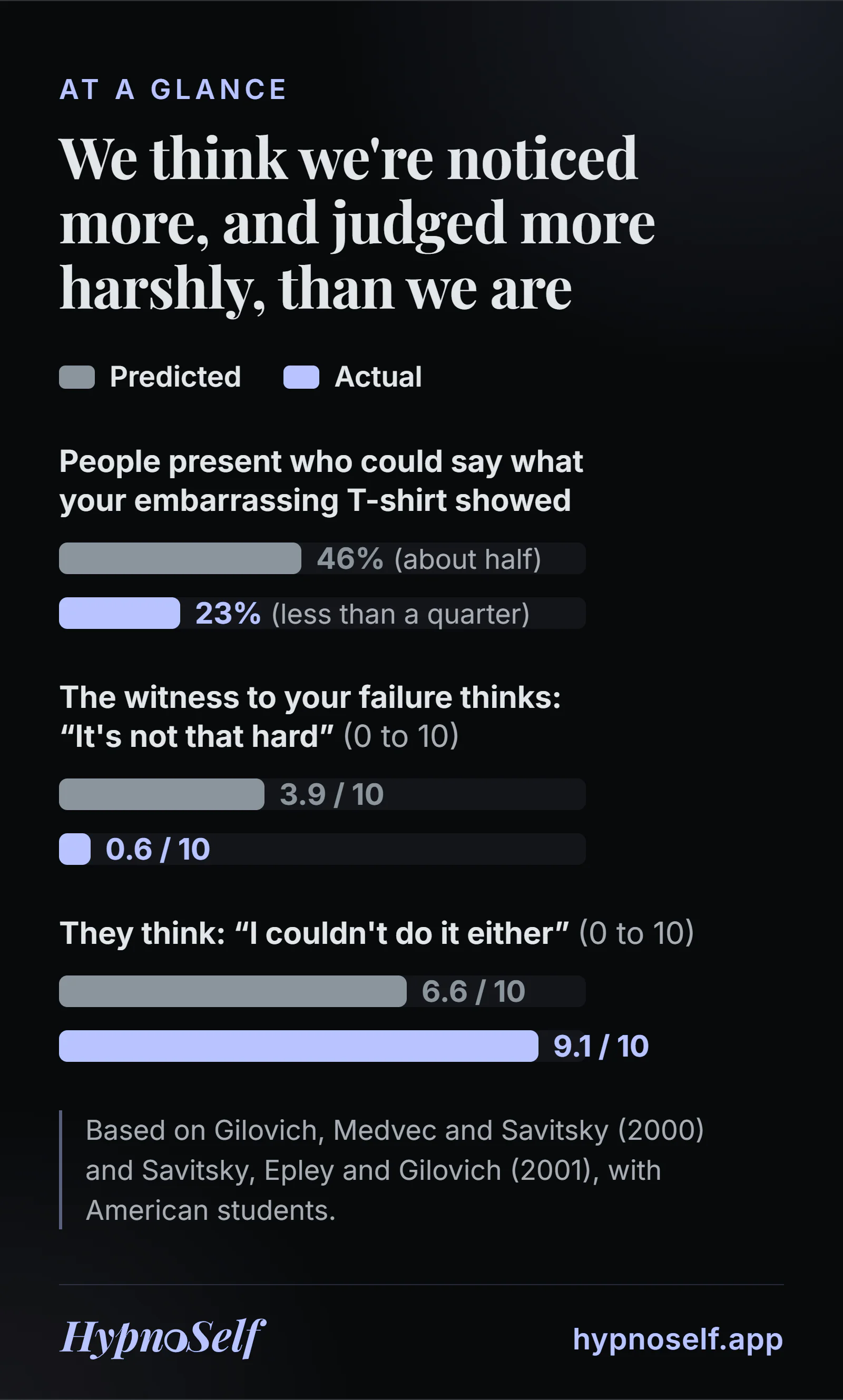
- You think you’re noticed far more than you are. Students who briefly walked into a room in an embarrassing T-shirt thought nearly half the people there could say who was on it; in fact, just under a quarter could (Gilovich, Medvec and Savitsky, 2000).
- You also think you’re judged more harshly than you are. Students who failed at very hard anagrams, out loud and in front of another student, expected that student to think less of them; in fact, the onlooker rated them almost as intelligent as before the test (Savitsky, Epley and Gilovich, 2001).
- HypnoSelf, an app for affirmations, works with you to find the belief behind your dread of being looked at, then writes you sentences that you’ll record yourself.
| Key point | Value |
|---|---|
| What it is | the fear of being watched and judged, a common experience |
| What research shows | you’re noticed less than you think: students thought twice as many people had noticed their T-shirt as really had (Gilovich, 2000) |
| How to get past it | write down your fear beforehand, count the real looks, then work on the belief that feeds it |
Contents
What is the fear of judgment?
It’s the feeling that everything you do is watched and assessed, and that one slip will make people think badly of you. The phrase describes a common experience, not a diagnosis. You can recognize this fear by what it makes you avoid: walking into a place for the first time, or trying something in front of others.
Julie, 31, joined her neighborhood gym in September for $40 a month. She’s gone twice, both times with a friend whose schedule has since changed. Now, every evening, Julie slows down in front of the gym’s window, thinks, “Everyone’s going to see I don’t know how to use the machines,” and keeps walking home. By December, she’ll have paid for three months and gone twice.
The fear of judgment looks a lot like the fear of failure, but it’s less about failing than about being seen as a beginner.
Where does the fear of judgment come from?
You fear other people’s judgment because their opinion matters to you, and because you overestimate the risk of being judged badly. Researchers have measured two miscalculations: you think you’re noticed more than you are, and that the people who notice you are harsher than they really are.
You think you’re noticed more than you are
Julie is sure that “everyone’s going to see.” To test that kind of certainty, three American psychologists had 15 Cornell University students put on a T-shirt showing singer Barry Manilow, a shirt most of them would have been embarrassed to wear (Gilovich, Medvec and Savitsky, 2000). Each of them walked into a room where a few other students sat facing the door, filling out a questionnaire, and was quickly sent back out. Out in the hallway, each one estimated how many of those students could name the singer: close to half. In fact, fewer than a quarter could.
Other students, who only watched a video reenactment of the scene, predicted that far fewer people would recognize the singer. This shows that what inflates the estimate is being the one on display. The authors called this mistake the spotlight effect: you feel as if a spotlight were shining on you alone. One caveat: the groups of students were small, and the T-shirt was seen for only a moment.
At the gym, Julie is in the T-shirt wearers’ shoes: her “everyone’s going to see” is like their estimate, which was double the real number. The regulars are busy with their workouts, just as the students in the room were busy with their questionnaire.
You think you’re judged more harshly than you are
Julie also fears that the people who see her fumbling with a machine will judge her. The same team measured what someone who watches you fail actually thinks (Savitsky, Epley and Gilovich, 2001). Students at a college in Massachusetts took part in pairs. One of them, the solver, had to work out 16 anagrams (words with scrambled letters) out loud while the other, the witness, looked on. The test was presented as one that highly intelligent people do well on. But 14 of the anagrams were very hard, and solvers got fewer than three right on average.
The solver expected the witness to think less of them after this failure. Yet the witness, asked to rate the solver before and after the test, judged the solver almost as intelligent afterward as before. Witnesses also rated, from 0 (not at all) to 10 (very much), how much they had thought, “Why can’t [the solver] get the right answer? That anagram isn’t so hard.” On average, they gave this harsh thought less than 1, while solvers expected close to 4. Mostly, witnesses had thought, “Gosh, I don’t think I could solve these anagrams either,” which they rated 9 out of 10. Here too, there’s a caveat: the study involved only 14 pairs of students, and a single failure staged in a lab.
For Julie, the anagrams are the machine she can’t figure out, and the witness is the person waiting for that machine next to her. Like the witness in the study, that person is more likely to think “I had to figure it out too” than “she doesn’t belong here.”
Find your belief and reprogram it.
- You describe what holds you back
- The app writes your affirmations
- You record them in your voice
- You listen at bedtime
7 days free, no commitment
How do you overcome the fear of judgment?
To overcome the fear of judgment, put it to the test: predict in writing what other people will see, count what really happens, find the belief that makes you feel watched everywhere, then answer that belief every day with a sentence you can actually believe.
1. Write down what you think other people will see
Before you go somewhere you’re afraid to be seen, put numbers on the scene: how many people, how many looks, how many judgments. A fear on paper becomes a prediction, and a prediction can be checked.
On Sunday, Julie writes: “Tuesday around 7 p.m., about fifteen people. At least ten will see me trying to figure out a machine. Half will think I don’t belong there.”
2. Go and count the real looks
Go where you planned to go, stay as long as you’d decided, then write down what happened right away: the long stares, the comments. As in the T-shirt experiment, you’re comparing your prediction with reality.
On Tuesday, Julie stays forty minutes and spends a long time trying to work out how to adjust a seat. Before leaving, she sits on a bench and writes down two looks and one remark, from a man waiting for the machine: “The lever’s under the seat. I had to hunt for it my first time too.” Predicted: ten looks, five judgments. Counted: two looks and a helping hand.
3. Look for the belief that makes you feel watched everywhere
Counting only a few looks is reassuring, but the fear can come back the next time you’re somewhere new, because it rests on a belief: a general rule you apply to every situation like this one. To find that belief, ask yourself what a mistake made in front of others would say about you, then keep digging, one answer at a time, using the questions of the downward arrow, a technique from cognitive therapy.
For Julie, the chain of answers starts with the fear of being taken for a beginner, goes through “I don’t belong here until I know what I’m doing,” and ends at a rule: “People judge me the moment I don’t know how to do something.” If you’d like guidance, HypnoSelf’s assistant asks you these questions, building on each answer, until you reach the rule that keeps you at the door.
4. Give your belief a believable answer, every day
Answering your belief with “Nobody judges me” wouldn’t hold up: a single long stare would prove it wrong. Instead, Julie picks a step-by-step affirmation, backed by what she counted: “With every workout, I learn one more machine, and everyone there is busy with their own.” HypnoSelf drafts this kind of sentence from your belief, for you to record yourself.
When should you get support?
When the fear of judgment keeps you from going out or from seeing the people you love, a doctor or a psychologist can help. In that case, professionals may talk about social anxiety disorder, also called social phobia. Only they can make that diagnosis, and you would work on this fear with them.
HypnoSelf supports personal growth; it doesn’t replace help from a healthcare professional. If you’re going through a hard time, here’s who you can turn to.
Freeing yourself from the fear of judgment with HypnoSelf
“Julie, you’re allowed to learn in front of other people.” Among the sentences the app wrote for her, this one answers her rule, “People judge me the moment I don’t know how to do something,” by giving her permission rather than asking her to excel. It allows what the rule forbade: working out how to adjust a machine in public, in front of the regulars.
The sentence came out of a conversation in the app: Julie had described the seat she couldn’t adjust, and the AI assistant had asked her questions, step by step, until they reached her rule. Julie recorded the sentence in her own voice, as she did her other sentences, and listens to it every morning when she wakes up. Waking up and bedtime are the two moments the app suggests for speaking to your subconscious.
Her next milestone: one evening in January, pushing open the glass door without counting the looks.
Start the conversation. The conversation, your affirmations and your recording are free, no credit card needed. Listening then requires a card: it starts a 7-day free trial, cancel anytime before it ends, then a subscription.
Frequently asked questions
What is the fear of judgment called?
The fear of judgment has no single name: people also call it the fear of being judged or the fear of criticism. When this fear becomes intense and long-lasting, doctors use the term social anxiety disorder, also known as social phobia, a diagnosis that only a doctor or a psychologist can make.
Why does it feel like everyone is watching me?
Psychologists call it the spotlight effect: because you’re very aware of yourself, you assume others pay just as much attention to you. In a 2000 study, students who briefly walked into a room in an embarrassing T-shirt guessed that twice as many people could say who was on it as really could.
How do I get over the fear of judgment?
A judgment you imagine is hard to ignore, but you can check it. Experiments show that people overestimate how many others notice them, and how harshly they’ll be judged by those who watch them fail. Writing down your fears before going out, then counting the real looks, shows you this firsthand.
Is the fear of judgment the same as social anxiety?
Not necessarily. Fearing other people’s judgment is common and, most of the time, it bothers you without keeping you from living your life. Professionals use the term social anxiety disorder when the fear grows big enough to call for support; only a doctor or a psychologist can decide that.
HypnoSelf is an app for affirmations written from your own words, recorded in your own voice and heard as you wake up and fall asleep. This page was written by the HypnoSelf team.