Self-hypnosis: how to practice it on your own, and go further
By HypnoSelf · updated November 14, 2026

Self-hypnosis means focusing your attention on your own for a few minutes, then repeating a suggestion you chose in advance. You can try it for free, with no audio: one sentence, a timer, a spot to focus on, then counting your way back. In clinical trials, benefits show up mostly when people learn to practice it themselves, regularly.
In short
- Self-hypnosis means putting yourself into a state of focused attention, then repeating a sentence chosen in advance. The method on this page takes six steps and ten minutes, close to the steps described by Cleveland Clinic, the US medical center.
- Across 22 trials reviewed by Eason and Parris (2019), mostly with patients, 18 found a benefit. All 17 trials in which people learned to practice on their own found one.
- In four trials, notably with pregnant women, simply listening to a recorded hypnotist did no better than the comparison groups. Better to take part: sentences drawn from your own life, said by you and listened to every day.
- Joseph Murphy and Joe Dispenza recommend bedtime and waking up, when alertness drops: in their view, the subconscious takes in suggestions more easily then. Émile Coué, the French pharmacist who pioneered autosuggestion, already had people say his formula at those two moments.
| Key point | Value |
|---|---|
| Definition | “A self-induced, intentional trance” (Cleveland Clinic), with a goal set in advance |
| The method on this page | 6 steps, 10 minutes, based on the usual steps of self-hypnosis and on Coué, free and with no audio |
| Trials on self-hypnosis | 22, mostly with patients; 18 found a benefit (Eason and Parris, 2019) |
| What seems to matter | Learning to practice on your own, and more than three practice sessions |
| When the authors recommend it | At bedtime and when you wake up (Coué, Murphy, Dispenza) |
Contents
What is self-hypnosis?
Self-hypnosis, also called autohypnosis or self-hypnotherapy, is “a self-induced, intentional trance,” as a psychotherapist quoted by Cleveland Clinic, the American medical center, puts it. In plain terms: with no one guiding you, you focus your attention for a while, with a specific goal in mind.
A trance, here, is attention so focused that the world around you fades a little. It sometimes happens on its own, Cleveland Clinic’s article notes, when you’re absorbed in a book or a movie. A suggestion is a sentence or an image you offer yourself without forcing it, and you can open your eyes at any moment. Ericksonian self-hypnosis refers to Milton Erickson, an American psychiatrist who wrote about practicing self-hypnosis himself (Erickson and Rossi, 1977).
How does self-hypnosis work?
The authors who inspired HypnoSelf see it as a way into the subconscious mind. Joe Dispenza, who says that early in his career he “learned about and eventually taught hypnosis and self-hypnosis,” describes induction, the moment you go into a trance, as learning to change your brain waves. In the theta state, half awake and half asleep, “there is no veil between the conscious and subconscious minds,” he writes. Joseph Murphy cites experiments on people under hypnosis to argue that the subconscious doesn’t reason: it accepts whatever is suggested to it.
These authors give the conscious mind little weight. In Breaking the Habit of Being Yourself, Dispenza writes that “5 percent of the mind is conscious, struggling against the 95 percent that is running subconscious automatic programs.” Biologist Bruce Lipton argues that an affirmation fails when it contradicts a program you picked up as a child. HypnoSelf borrows a simple picture from them: a sentence repeated while you’re wide awake, say in front of the mirror, gets caught in a conscious filter, and induction, like falling asleep, lowers that filter. That’s why the app starts from your own belief before writing a single sentence: use the conversation to pinpoint the belief your sessions should target.
How do you do self-hypnosis at home?
You write a sentence, settle in for ten minutes with a timer, focus your attention, relax your body, repeat your sentence, then count your way back. The steps broadly follow Cleveland Clinic’s, two habits come from Coué, and the timings are only a suggestion: adjust them to your own pace.
The six steps of a session
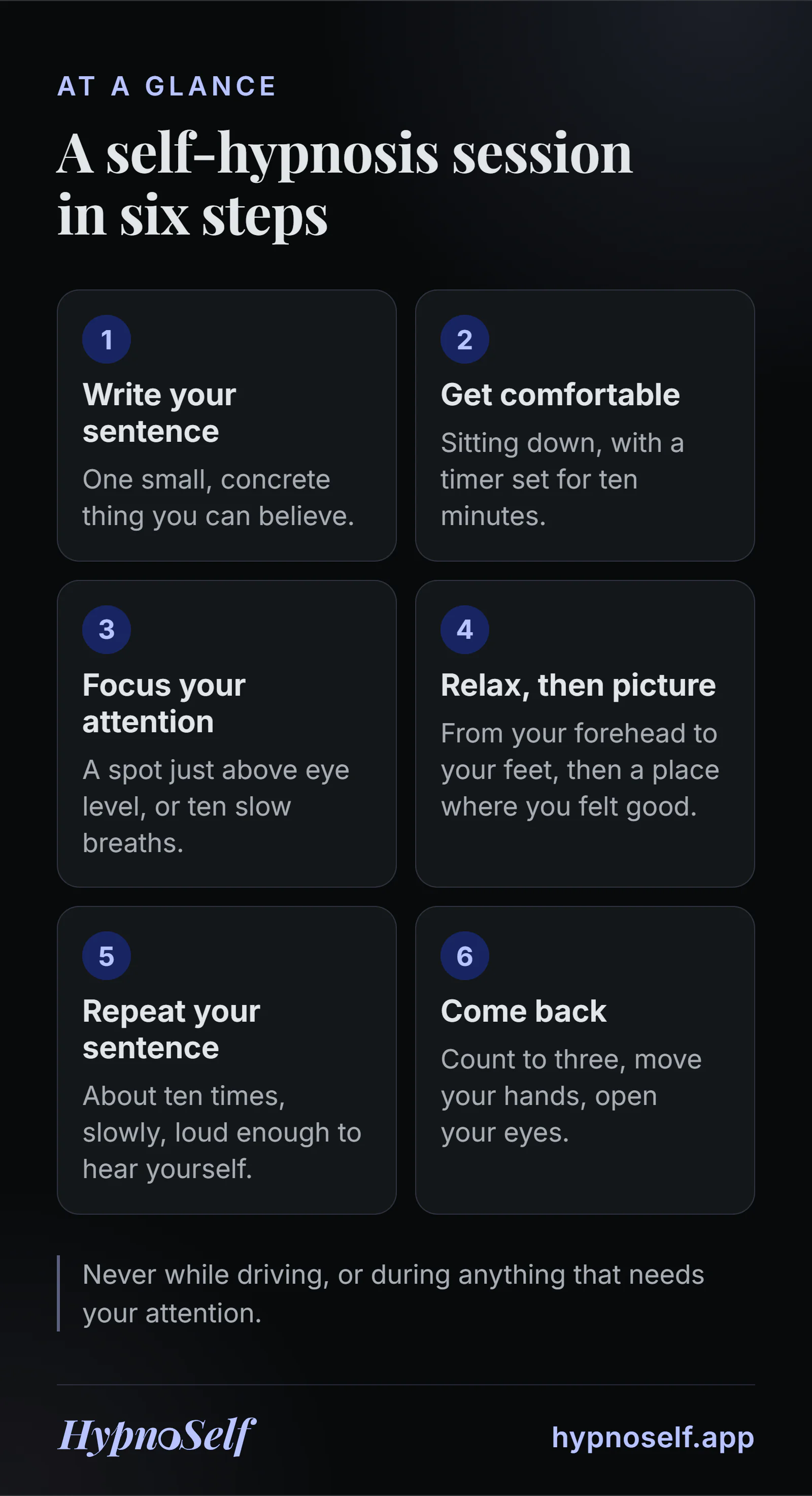
- Write your sentence before you start. One thing, small and concrete, written like a positive affirmation you can believe: “My shoulders drop a little more with every breath,” which your body can check; “I’m getting a little calmer every evening,” which describes progress; or a question your mind sets out to answer, like “Why do I feel more relaxed?”
- Settle in and set a timer for ten minutes. That way, you won’t have to watch the clock. Sitting up, you’re less likely to fall asleep than lying down. Never while driving, or during anything that needs your attention.
- Focus your attention. Rest your eyes on a spot slightly above eye level until your eyelids want to close, or count ten slow breaths. Cleveland Clinic’s guide uses the same approach: a simple point in your line of sight and slow breathing, until your eyes close on their own.
- Relax your body, then picture a place where you felt good. Scan your body from your forehead down to your feet, then bring back the sounds and the light of that place, real or imagined. If nothing comes to mind, stay with your breathing.
- Repeat your sentence. About ten times, slowly, loud enough to hear yourself. Émile Coué, the French pharmacist behind the popular “Every day, in every way, I’m getting better and better,” already had people repeat his formula with their lips moving, in an even voice, and without effort.
- Come back. Count to three, as Coué did with the people he worked with, move your hands, open your eyes. Wait a minute before you get up, and don’t drive right away: this kind of relaxation can make you less alert.
Why the sentence matters so much
A sentence you know is false doesn’t get through: as Murphy writes, your subconscious accepts “what you really feel to be true, not just idle words or statements.” If you tell yourself “I’m perfectly calm” on an evening when everything is getting to you, the sentence slides right off. A sentence about progress gets through better: if public speaking makes you freeze, “I’m getting more comfortable every time I speak up” rings true, where “I’m a great public speaker” would ring false.
Questions help too: they don’t claim anything, so your mind has nothing to argue with, and it starts looking for an answer. American author Noah St. John calls them “afformations” in The Book of Afformations (2013). In HypnoSelf, the app mixes these forms, and if a sentence still grates on you, it offers an in-between version, one notch down.
What can happen during a session
| What happens | What you can do |
|---|---|
| Your thoughts wander | Come back to your spot or your breathing, without blaming yourself |
| You fall asleep | Sit up next time, or pick another time of day |
| You don’t feel anything special | No particular sensation is required: how responsive people are to hypnosis varies from one person to the next |
| A headache, dizziness, an emotion or a painful memory | Open your eyes and stop. If it keeps happening, a doctor or a psychologist can help |
How long, and how often?
The trials that find a benefit often have people practice more than three times. For meditation, which he likens to self-hypnosis, Dispenza advises beginners to do one session a day, and says he meditates around the same time every morning.
To begin. Ten minutes a day, at the same time, for two weeks, before you judge what difference it makes.
Find your belief and reprogram it.
- You describe what holds you back
- The app writes your affirmations
- You record them in your voice
- You listen at bedtime
7 days free, no commitment
Can you learn self-hypnosis on your own?
Yes, you can start on your own, as long as you learn the technique and practice it several times. In Eason and Parris’s review, all 17 trials in which people learned to practice by themselves found a benefit. Most began with a guided session, but two did without one and still found a benefit, with more than three practice sessions.
The two paths don’t compete: a licensed health professional trained in hypnosis can show you how, then you keep going at home. Coué started out putting his patients to sleep, then stopped when he found that sleep was “not indispensable,” and taught them to practice on their own, awake.
When you start out alone, two things are hardest: finding the right sentence, and letting go of your alertness. HypnoSelf takes care of the first with the conversation, and leaves the second to the moment you fall asleep.
Does self-hypnosis work?
Trials often find a benefit, especially with patients, when people learn to practice on their own and keep it up for more than three sessions. In healthy people, mostly medical students, six trials out of nine found less stress, an encouraging result their authors want to see confirmed. How you practice makes a big difference.
What the trials measured
A trial assigns participants to groups at random, which makes a fair comparison possible. A review pulls together the trials on the same question.
| Source | Who | Compared with | Result |
|---|---|---|---|
| Eason and Parris, 2019 | 22 trials, mostly patients: pain, childbirth, children. 3 trials on stress and anxiety, with 10 to 20 people per group | Usual care, a wait list (a group waiting its turn) or another method | 18 found a benefit, including 14 against another active method |
| Fisch et al., 2017 | 9 trials, 365 healthy people, mostly medical students, hypnosis in the broad sense | No intervention or another method | Less stress in 6 trials out of 9, a result the authors say needs confirming |
| Whitehouse et al., 1996 (included by Fisch) | 35 first-year medical students, volunteers, followed for a semester, 14 group sessions | No training | Less self-reported distress and anxiety |
| Cardeña et al., 2013 | 35 volunteers | Wait list | Less stress and burnout after 2 weeks of listening to a recording |
What seems to matter: taking part
Eason and Parris point to two traits common among the trials that find a benefit: learning to practice on your own, and more than three practice sessions. The 4 trials that found none, including their two largest (1,222 and 672 pregnant women), reduced self-hypnosis to listening to a recorded hypnotist, without teaching people to do anything themselves, and three of them lasted three sessions or fewer. They dealt with childbirth and with sleep after cancer. According to Eason and Parris, the authors of one of them thought training better tailored to each person might change the outcome.
The practical takeaway: don’t let listening be the only thing you do. Start from your own situation, say your sentences yourself, then listen to them again every day, for weeks. That’s how HypnoSelf works: the conversation starts from what you’re going through, the app writes your sentences, and you say them out loud to record them. You can get your sentences and record them in your own voice.
The method on this page builds in both traits Eason and Parris point to: it teaches you the technique, then has you practice every day, well over three times. The authors who inspired HypnoSelf lean the same way: Coué recounts, case by case, patients he says he helped, Murphy describes the same work on the edge of sleep, and Dispenza, who taught self-hypnosis, calls meditation and self-hypnosis “similar.” The best way to find out what it does for you is to try it: ten minutes a day, for two weeks.
With a practitioner, clinical hypnosis has its own evidence: an overview by Rosendahl and colleagues (2024), which pulls together 49 meta-analyses and 261 studies of patients, finds the strongest results for pain and medical procedures. For the details, see what research has measured about hypnosis.
What is self-hypnosis used for?
People use it to relax, handle stress and anxiety, prepare for a moment they dread, wind down at bedtime or build confidence. The method stays the same from one use to the next: only the sentence changes, and you choose one you can believe.
For the stress that builds when the bills are due, right before you open your banking app, “I look over my accounts calmly, one line at a time” gives you something you can actually do, rather than a state to reach. Self-hypnosis for sleep is done in bed, with no timer, and a sentence that sets the day aside: “My list keeps track of what’s left to do” hands your worries to paper instead of to your night.
Hypnosis for confidence uses the same steps, with one specific situation in mind. Before a first date, “I’m allowed to be myself, and to see whether I like them” takes off some of the pressure: you’re no longer only trying to be liked, you’re choosing too. To let go in the evening, “You don’t have to sort everything out tonight” is said the way you’d talk to a friend you’re supporting: the “you” makes it gentler.
In HypnoSelf, the app writes sentences like these from what you shared in the conversation, in your own words, around whatever is holding you back.
Self-hypnosis, autosuggestion, affirmations, meditation: what's the difference?
Self-hypnosis starts by focusing your attention, then you give yourself a suggestion. Coué’s autosuggestion repeats a single sentence, without effort and with no settling-in phase first. Affirmations are sentences about yourself, chosen for what you’re working toward. Hypnosis is done with a practitioner, and guided meditation most often with a teacher or a recording.
| Practice | Who guides | What you do | What sets it apart |
|---|---|---|---|
| Self-hypnosis | You | Focused attention, then a suggestion | A focusing phase at the start, a return at the end |
| Hypnosis in session | A practitioner | They guide your attention and offer the suggestions | The setting of clinical studies on hypnosis |
| Autosuggestion (Coué) | You | One sentence, 20 times on waking and at bedtime | No settling-in phase, the same sentence for everyone |
| Positive affirmation | You | A few sentences said out loud every day | Sentences specific to each person |
| HypnoSelf | You, with the app | Your sentences, recorded in your voice, heard as you fall asleep or wake up | Sentences written around your belief, and the natural letting-go of sleep |
| Guided meditation | Often a teacher or a recording | Breathing, attention, sometimes mental imagery | Its own exercises |
Coué didn’t call his practice self-hypnosis, but he wrote that autosuggestion “is nothing but hypnotism as I see it.” Researchers still debate how Coué’s autosuggestion relates to self-hypnosis: hypnosis researcher André Weitzenhoffer keeps them apart, Eason and Parris note. HypnoSelf borrows from both: you listen to your own suggestions, relaxed, on the edge of sleep. Hypnosis vs. meditation is a separate debate, between two practices that share relaxation and focused attention.
Is self-hypnosis dangerous?
Good news: it’s a gentle practice, and you stay in control from start to finish. Cleveland Clinic calls hypnosis safe and low-risk, and says side effects after a session with a hypnotherapist are rare: dizziness, drowsiness, a headache, more anxiety or trouble sleeping. Its article on self-hypnosis adds that the practice is safe for most people.
A review of hypnosis in general backs this up: these side effects are usually brief, and the rare more serious cases almost always occur in clinical sessions or stage shows (Gruzelier, 2000). To practice at home with peace of mind, two habits limit the risks of self-hypnosis: never while driving, and if a painful memory comes up, open your eyes and stop. If you’re under medical care, talk to your doctor first; Cleveland Clinic also advises checking with a professional before you start if you live with schizophrenia or a dissociative disorder, or have a history of seizures.
Self-hypnosis can also go alongside care: with depression or long-standing insomnia, it comes on top of treatment, never in place of it. For insomnia, cognitive behavioral therapy for insomnia (CBT-I), done with a professional, has strong evidence behind it (van Straten et al., 2017), and the two can go hand in hand.
HypnoSelf supports personal growth; it doesn’t replace help from a healthcare professional. If you’re going through a hard time, here’s who you can turn to.
Do you need audio or an app for self-hypnosis?
No: the method on this page needs neither, and it’s free. A recording can help: in 8 trials gathered by Eason and Parris, it supplemented a practice people had learned to do on their own, with a benefit every time. It all depends on what you listen to, and how much you take part.
When you compare hypnosis apps, one question helps: do they just have you listen to someone else’s voice, or have you take part, with your words and your voice? HypnoSelf was built for the second, and takes care of three moments of the session above.
- The sentence from step 1. A conversation with an AI assistant starts from what you tell it and digs down to the limiting belief holding you back. Gregg Braden suggests a similar approach: name your belief, state its opposite, then back up that goal with facts from your own experience. The app then writes 25 to 30 affirmations aimed at that belief, with the words you used, in the “I” form, the “you” form, with your first name or as questions. That personalization is what HypnoSelf adds: Coué gave everyone the same formula.
- Your sentence repeated, as in step 5. You record your affirmations yourself, over a background track. Coué had people say his formula, lips moving, rather than just think it, and Dispenza suggests recording yourself reading the script of a meditation: two precedents that count among the reasons to listen to your own voice.
- The focus and relaxation of steps 3 and 4. Sleep takes care of them: you listen in the evening as you fall asleep or in the morning as you wake up, and a timer turns the sound off. Falling asleep does on its own what Dispenza credits to hypnotic induction: sleep recordings show the brain shifting from the beta waves of alertness to alpha, then theta waves, those of drowsiness. As Murphy puts it, in that sleepy state “the conscious mind is submerged to a great extent.”
- Alertness Beta 14 to 30 Hz
- Relaxation Alpha 8 to 13 Hz
- Drowsiness Theta 4 to 8 Hz
When your ritual plays, between relaxation and drowsiness
Start the conversation. The conversation, your affirmations and your recording are free, no credit card needed. Listening then requires a card: it starts a 7-day free trial, cancel anytime before it ends, then a subscription.
Frequently asked questions
How do you self-hypnotize?
A session takes six steps: write a sentence, settle in with a timer, focus your attention, relax your body, repeat your sentence, then come back by counting to three. The steps broadly follow those described by Cleveland Clinic, the US medical center, and two habits come from Émile Coué, the pioneer of autosuggestion. Start with ten minutes a day.
How long does it take for self-hypnosis to work?
It varies from person to person. A 2019 review, mostly of trials with patients, found benefits more often when people practiced more than three times, and trials with healthy people lasted anywhere from two weeks to a semester. Your best bet: practice every day, at the same time, for at least two weeks before judging.
Is it safe to hypnotize yourself?
The risks are low: Cleveland Clinic considers self-hypnosis safe for most people, and minor side effects, such as a headache or dizziness, are rare and usually brief. Never practice while driving, stop if a painful memory comes up, and if you live with schizophrenia or a dissociative disorder, check with a professional first.
Can hypnosis cure depression?
Not on its own: depression calls for care from a doctor or a psychologist, and self-hypnosis doesn’t replace that care. It can, however, go alongside it day to day, like listening to your own affirmations, to help you relax or work on a belief that weighs on you.
HypnoSelf is an app for affirmations written from your own words, recorded in your own voice and heard as you wake up and fall asleep. This page was written by the HypnoSelf team.