Lack of confidence: why you can't bring yourself to go for it
By HypnoSelf · updated November 16, 2026

A lack of confidence, or low self-confidence, means doubting you can do what you’d like to try, so much that you give up before you start. It can grow out of things you heard early on, then keep going because you avoid what scares you. It isn’t a diagnosis, and you can rebuild your self-confidence by trying small things.
In short
- A lack of confidence can start with a few words you hear about yourself. In one experiment, children who were told that an unfamiliar animal was dangerous hesitated longer before reaching into the box where they thought it was hidden, even though they had never seen it (Field and Lawson, 2003).
- A lack of confidence keeps going when you avoid what scares you: if you never try, you never find out that the worst doesn’t happen, as psychologist Paul Salkovskis (1991) explains.
- In the HypnoSelf affirmations app, a conversation brings up the sentence holding you back; you then record sentences written to answer it, in your own voice.
| Key point | Value |
|---|---|
| Definition | doubt about your abilities in certain situations, not a diagnosis |
| The first sign | giving up before you’ve even tried |
| What keeps it going | avoidance, which stops you from checking whether the fear was exaggerated |
Contents
What is low self-confidence?
Low self-confidence is doubt about your abilities in specific situations: dancing, speaking in public, asking for a raise, approaching someone you’re attracted to. You can be comfortable at work and lose your nerve on a dance floor. A lack of confidence shows up mostly in what you hold back from doing.
Clara is 34. For two years, she’s wanted to join the Thursday night beginner salsa class in her neighborhood. She opens the sign-up page, types her name, then closes the tab. When her boyfriend, Simon, encourages her, she says, “I’d love to, but I can’t do it. I’ll look ridiculous.”
Low self-esteem is about something else: how you judge your overall worth. Clara thinks fairly well of herself; it’s only on a dance floor that she feels incapable.
What are the signs of a lack of confidence?
The clearest sign is giving up before you’ve even tried, and always having a good reason for it. The table below shows the other signs, as they appear for Clara. One sign alone doesn’t mean much; what counts is whether it keeps coming back in the same kind of situation. Feeling nervous the night before an exam, for example, is normal, and on its own it doesn’t mean you lack confidence.
| Sign | How it shows up for Clara |
|---|---|
| You give up before trying | she fills out the sign-up form, then closes the tab |
| You put things off | “I’ll sign up in September,” two Septembers in a row |
| You imagine the worst | “Everyone will see I can’t dance” |
| You hold back | at some friends’ wedding this summer, she watches the bags while Simon dances |
| You brush off encouragement | when Simon says she moves well: “You’re just saying that to be nice” |
Find your belief and reprogram it.
- You describe what holds you back
- The app writes your affirmations
- You record them in your voice
- You listen at bedtime
7 days free, no commitment
What causes a lack of confidence?
A lack of confidence often comes from what you went through or heard about yourself, as a child or later: being mocked in front of others, repeated criticism, a parent who did everything for you, failures that hit hard. What stays with you is a belief about yourself, and that belief then holds you back.
For Clara, it all goes back to one sentence. In eighth grade, during the dance unit in gym class, the teacher made her do it again, alone, in front of the class, then called out, “Clara, you’ve got two left feet!” Everyone laughed. She’s avoided dance floors ever since.
Two researchers measured the power of a few words (Field and Lawson, 2003). Their experiment involved 59 children aged 6 to 9 and small Australian marsupials unknown to the children. For each animal, a child was given threatening information, reassuring information, or none, then had to reach into a box where they believed the animal was hidden. After the threatening information, the children took longer to do it, though they had never met the animal. The experiment looks at a brand-new fear; it says nothing about what that fear becomes years later.
So a fear can grow out of what you hear. For Clara, the box is the dance floor, and her teacher’s “two left feet” is the threatening information: she learned to dread dancing before learning to dance.
Why does a lack of confidence take hold?
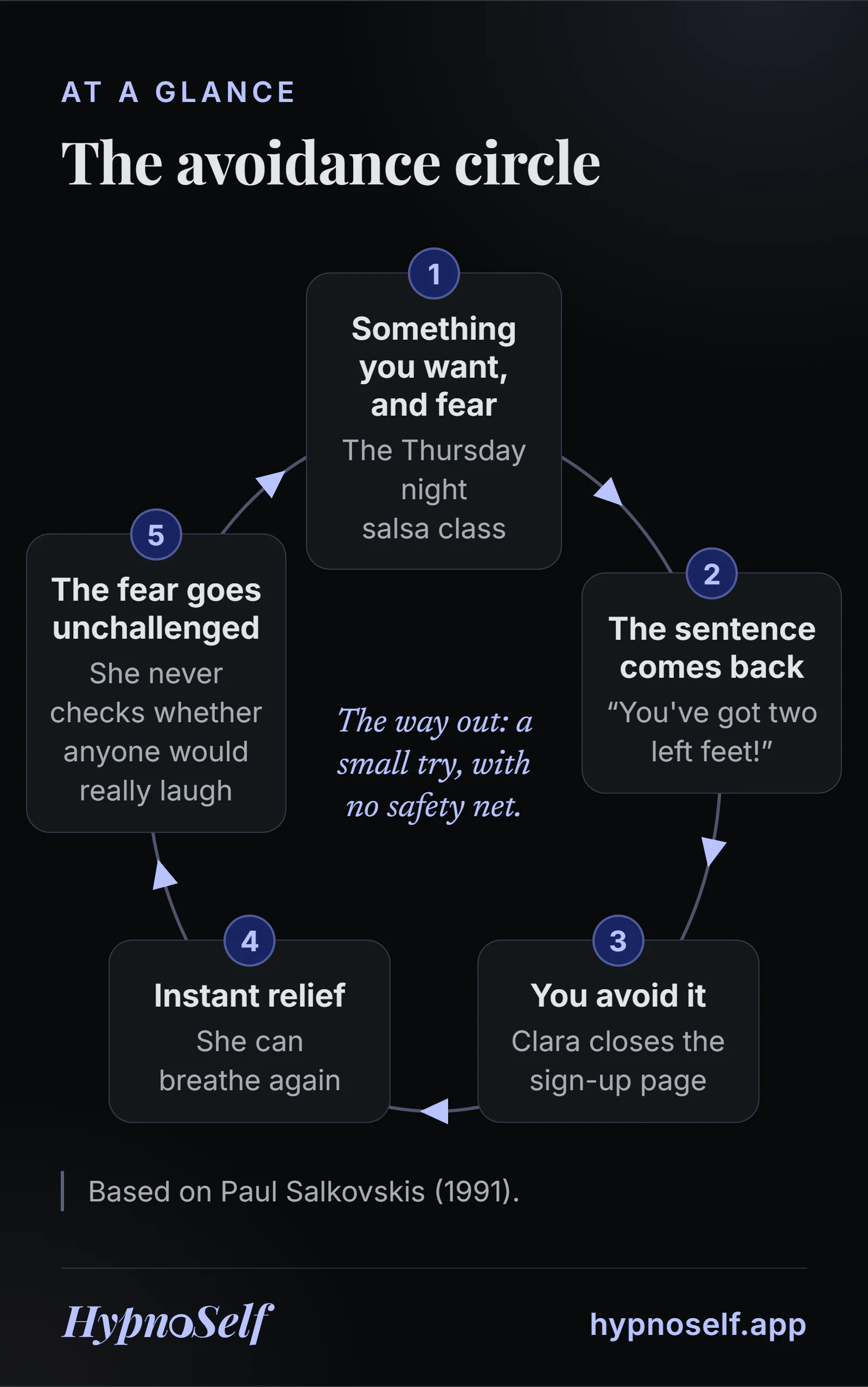
Because you avoid what scares you. Avoidance brings instant relief, but it keeps you from checking whether the fear was exaggerated: the belief stays intact, and every missed chance strengthens it. Over time, the lack of confidence spreads to other situations.
British psychologist Paul Salkovskis calls these avoidance moves safety-seeking behaviors: in his view, they keep you from finding out that the disaster you dread doesn’t happen (Salkovskis, 1991). A team in Sydney observed this in the lab (Lovibond and colleagues, 2009). Volunteers learned that a signal meant an electric shock was coming, and that pressing a button let them avoid it. Then the shocks stopped. One group kept the button; the other no longer had it. In the final test, with no button for anyone, the group that had gone without it expected the shock less and less, while the group that had kept it still expected the shock, and their bodies still reacted to the signal.
Closing the tab is Clara’s button: it brings relief, but she never checks whether anyone would really laugh, so her gym teacher’s “two left feet” is never proven wrong. And her avoidance is spreading: this year, Clara has also turned down her friends’ invitations to go dancing.
How do you overcome a lack of confidence?
When your confidence is low, four steps help you break out of the vicious circle of avoidance: spot what you avoid, find the sentence that stops you, take a small step without your usual safety net, then repeat, each day, a sentence you can believe.
1. List what you avoid
Write down the situations you put off or leave early, and what you do instead. Together, they show where your lack of confidence is at work.
Clara writes: “Salsa class: I close the page. Weddings: I watch the bags. My friends’ nights out dancing: I say I’m tired.” That’s three ways of avoiding the same thing: dancing in front of other people.
2. Find the sentence that stops you
Take one situation you avoid. Write down the sentence that comes to mind as you give up, ask yourself what would happen next, and keep asking until you reach a judgment about yourself. Often, someone said that judgment to you long before you thought it yourself: that’s your belief. Other questions can help you identify your limiting beliefs.
Clara starts with the salsa class: “I’ll get the steps wrong.” What would happen next? “The others will laugh, like they did in eighth grade.” And what would that laughter say about her? “That I can’t do it, that I’ll look ridiculous.” What her gym teacher said in eighth grade has become what she tells herself. In HypnoSelf, an AI assistant asks about your own situation, one question at a time, until you reach your belief.
3. Take a small step, without your safety net
Choose a smaller version of what you avoid, and do it without your usual safety net: no seat by the exit, no excuse ready. Beforehand, rate what you fear from 0 (nobody notices anything) to 10 (everyone makes fun of you); afterward, rate what actually happened.
The dance school offers a free trial class. Clara goes one Thursday, promising herself she won’t hide in the back row. She had predicted an 8. She gets the steps wrong and steps on her partner’s feet twice; he smiles and says, “It’s my third class, and I do the same thing.” Nobody watches her more than anyone else. She writes down a 2.
This time Clara didn’t back out or hide, and she saw for herself that the disaster she feared didn’t happen. You tend to think you’re being watched far more than you are: that’s one of the drivers of the fear of judgment.
4. Pick a sentence you can believe, and repeat it every day
One class won’t shake her belief that she can’t do it. To answer that belief, Clara builds on that Thursday instead of telling herself “I’m a great dancer,” which she would argue with right away. She picks “I’m learning salsa like everyone else, by getting it wrong first.” When it rests on something you’ve actually experienced, a positive affirmation has a chance of sticking. For your own sentences, the app writes them from the belief you found, and you record them by reading them aloud.
Who can help when a lack of confidence weighs on you?
When a lack of confidence keeps you from doing what matters to you, or comes with anxiety that doesn’t let up, a psychologist or therapist can help you understand where it comes from. There are several approaches, and your primary care doctor (or GP) can refer you to a professional.
HypnoSelf supports personal growth; it doesn’t replace help from a healthcare professional. If you’re going through a hard time, here’s who you can turn to.
Overcoming your lack of confidence with HypnoSelf
After the trial class, Clara still hesitates to sign up for the full session. She opens the HypnoSelf conversation and types, “Nobody laughed on Thursday, and I still can’t sign up.” The AI assistant asks what’s still holding her back. She talks about the class laughing at her in eighth grade. Then it asks, “When you think back to that day, what do you think it says about you?” The answer comes on its own: “I can’t do it. I’ll look ridiculous.”
The app turns that answer into affirmations, one of them a question: “Why am I a little bolder every week?” To answer it, Clara thinks back to the trial class, whereas a sentence like “I’m a great dancer” would only make her argue back. She records these affirmations in her own voice, then listens to them once she’s in bed.
The next salsa session starts in January. This time, Clara plans to make it all the way through the sign-up page.
Start the conversation. The conversation, your affirmations and your recording are free, no credit card needed. Listening then requires a card: it starts a 7-day free trial, cancel anytime before it ends, then a subscription.
Frequently asked questions
What are some examples of a lack of confidence?
Common examples are giving up before you try, putting things off, imagining the worst, constantly comparing yourself with others, holding back, brushing off compliments, saying yes so you don’t disappoint anyone, and dreading other people’s judgment. There’s no official list, and every website has its own, but these are the examples that come up most often.
What causes a lack of self-confidence?
A lack of self-confidence can start with criticism or teasing you heard about yourself, then keep going because of what you avoid. In a 2003 experiment, children who had been told that an unfamiliar animal was dangerous hesitated longer before reaching into the box that supposedly held it.
Is a lack of confidence a disorder?
No. A lack of confidence is doubt about your abilities in certain situations, not a diagnosis. It can come with anxiety or a period of feeling low. When it gets in the way of everyday life or has lasted a long time, a doctor or psychologist can help.
Who should I see about low self-confidence?
When a lack of confidence weighs on you day to day, a therapist or psychologist can support you, and your primary care doctor can refer you. If your doubt is limited to one situation, working on it yourself also helps: spot what you avoid, then try it in small steps.
HypnoSelf is an app for affirmations written from your own words, recorded in your own voice and heard as you wake up and fall asleep. This page was written by the HypnoSelf team.