Letting go: no longer carrying what's out of your control
By HypnoSelf · updated November 16, 2026

Letting go means no longer fighting what you can’t control, so you can put your energy back into what you can. The philosopher Epictetus drew this distinction nearly two thousand years ago. Letting go isn’t giving up or accepting everything, and you can learn how to let go: start by sorting, on paper, what’s up to you from what isn’t.
In short
- The Greek philosopher Epictetus separated what is in our control, like our opinions and our desires, from what isn’t, like our property or what others think of us.
- Letting go starts with accepting what you feel, not necessarily the situation. In three American studies, people who usually welcomed their emotions without judging them felt a little less distressed during stressful moments. Among 208 female college students, accepting the situation itself showed no link to well-being (Ford and colleagues, 2018).
- HypnoSelf, an affirmations app, uses a conversation to draw out the belief holding you back, then turns it into affirmations that you record out loud and play back at bedtime or in the morning.
| Key point | Value |
|---|---|
| What the phrase means | to stop fighting what you can’t control, so you can act on the rest |
| What letting go isn’t | giving up, or staying in a situation that hurts you |
| Where the idea comes from | Epictetus and his distinction between what is in our control and what isn’t |
| What researchers have observed | welcoming your emotions without judging them goes with less distress (Ford, 2018) |
Contents
What does letting go mean?
Letting go means loosening your grip on what you can’t control, like someone else’s decision or the outcome you’re waiting for. You drop the need to control everything that happens and put that energy into what you can still act on.
Vincent is 32. He and his girlfriend, Jenna, want to move in together for the first time. On Tuesday, they toured a bright one-bedroom apartment. The property manager has about ten applications and will reply “by Friday.” Since then, Vincent has been checking his email every ten minutes, even in meetings, and going over their application in his head: “I should have included the pay stub that shows my bonus.” “What if eight months at my new job doesn’t seem long enough?” Jenna told him, “We sent everything. Now we wait.” He can’t just wait.
Vincent can’t change the property manager’s choice, yet that’s where all his energy goes. For him, letting go would mean putting it somewhere else.
What you can control, and what you can't
Epictetus, a Greek philosopher and former slave, taught around the year 100. His student Arrian turned those lessons into a short handbook, the Enchiridion, which begins: “Some things are in our control and others not” (Epictetus, Enchiridion, translated by Elizabeth Carter).
Epictetus puts our opinions and what we pursue, desire and avoid on one side, and everything else on the other: the body, property, reputation (what others think of us) and positions of authority. In his view, we suffer when we treat what belongs to others as our own. From this he draws an exercise: when a thought troubles you, ask whether it concerns something in your control, and if it doesn’t, “be prepared to say that it is nothing to you.”
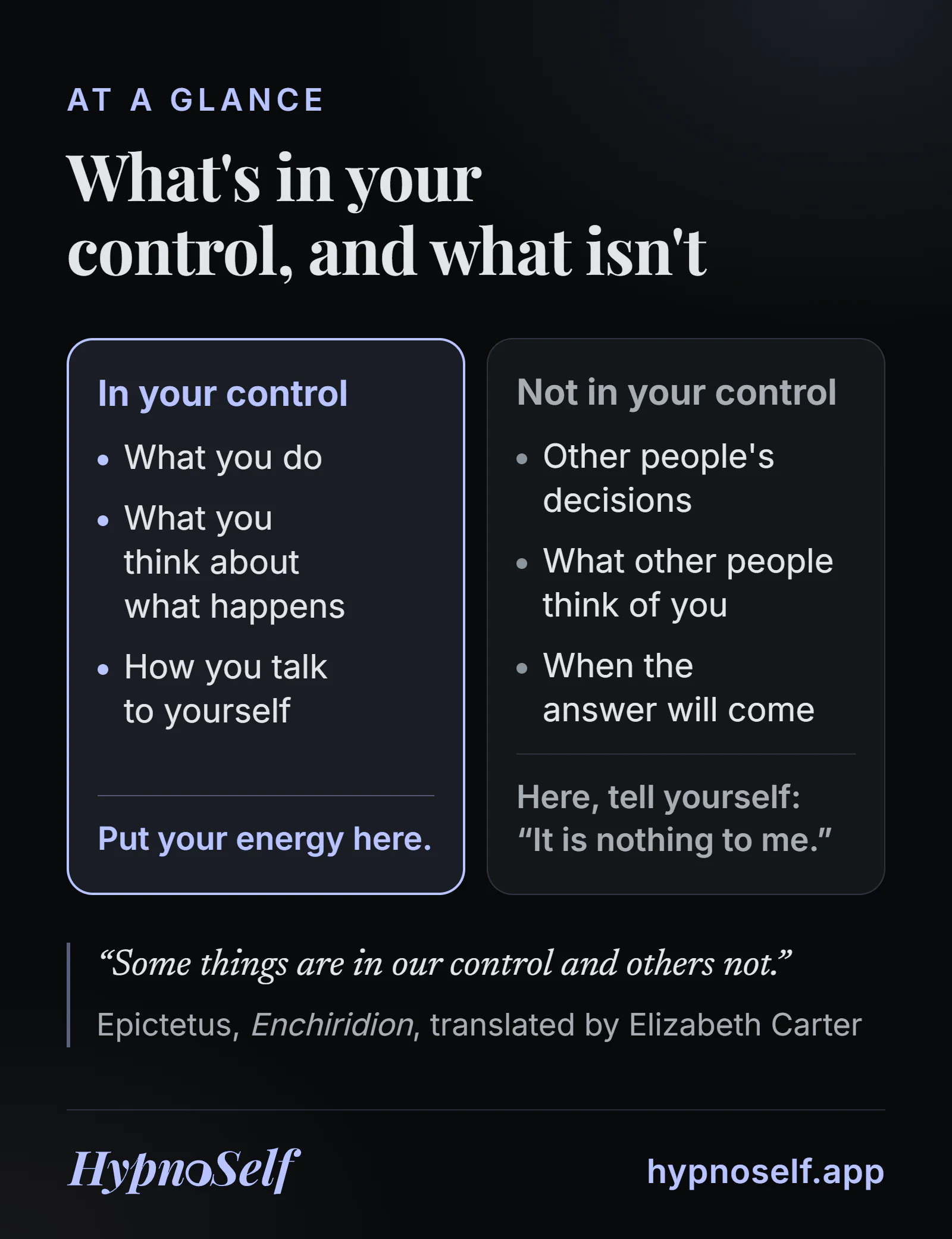
The property manager’s choice isn’t up to Vincent, just as, in Epictetus’s list, what others think of us isn’t up to us. His application, and the way he talks to himself while he waits, are up to him. Yet he wears himself out watching the rest.
Find your belief and reprogram it.
- You describe what holds you back
- The app writes your affirmations
- You record them in your voice
- You listen at bedtime
7 days free, no commitment
Is letting go the same as giving up?
No. Giving up means abandoning what’s up to you as well. Letting go means putting your energy there and withdrawing it from the rest. Vincent can keep looking for an apartment and just stop watching a decision that isn’t his to make. What he first has to accept is his worry, not necessarily the situation.
Researchers have measured the difference between accepting what you feel and accepting what happens. A team at the University of California, Berkeley (Ford, Lam, John and Mauss, 2018) first asked 156 women online how much they usually judge their own emotions, for example by telling themselves they shouldn’t feel what they feel. A few days later, in the lab, each had two minutes to prepare a three-minute videotaped speech, as if applying for a job, that judges would evaluate. Based on how they rated their emotions afterward, the women who usually welcomed their emotions without judging them felt a little less distressed during the task.
The same team found this in everyday life too. 222 adults in the Denver area who had recently been through a difficult event described, each evening for two weeks, the most stressful moment of their day. Those who welcomed their emotions without judging them were less distressed by those moments. And those who were less distressed were in better psychological health six months later.
Accepting the situation itself, on the other hand, doesn’t seem to help. In another part of the study, 208 female Berkeley students rated how much they accepted what happened to them, telling themselves, for instance, “It happened, and I have to live with it.” This way of coping wasn’t linked to any measure of psychological health, good or bad. The authors note that these studies observe people describing how they usually cope. Such studies show that two things go together, without proving that one causes the other; that would take experiments.
So the message is fairly encouraging: you don’t have to force yourself to accept what happens to you. Letting go starts with what you feel. When Vincent tells himself, “It’s ridiculous to stress over an apartment,” he’s judging his worry, like the women who told themselves they shouldn’t feel what they felt. He doesn’t have to like this wait; he can stop blaming himself for being worried.
Letting go never means staying in a situation that hurts you. If a partner puts you down, or you’re treated unfairly at work, what’s up to you is protecting yourself: getting help, and leaving if you need to.
How do you let go?
To let go of things you can’t control, four steps can help: sort what’s up to you from what isn’t, do your part fully and then stop, let your worry exist without judging it, and find the belief that has you carrying everything. Vincent goes through them from Wednesday to Friday.
1. Sort what’s up to you from what isn’t
Draw two columns on a sheet of paper and list everything about your situation: on the left, what’s up to you; on the right, what isn’t. It’s Epictetus’s sorting exercise, on paper. As long as everything stays jumbled in your head, every item feels like yours to carry.
On Wednesday evening, at the kitchen table, Vincent fills out his sheet:
| What’s up to Vincent | What isn’t up to him |
|---|---|
| Making sure his application is complete | The property manager’s and landlord’s decision |
| Calling the property manager once, politely | How many other people applied, and who they are |
| Looking at other listings with Jenna | The day and time of the answer |
| What he does with his evenings while he waits | What the property manager thinks of his eight months on the job |
Reading it over, Vincent sees that everything he was checking every ten minutes is on the right. The next day, when the worry about his eight months on the job comes back in a meeting, he tells himself, as Epictetus would: “That’s their decision.”
2. Do your part fully, then stop
From the left-hand column, pick what can still make a difference, and do it completely. Doing half of it leaves a doubt, and the doubt sends you back to checking. Once your part is done, there’s nothing left to check.
On Thursday morning, Vincent calls the property manager and sends the pay stub that shows his bonus: his application is complete, and the answer will come Friday. At lunch, he and Jenna apply for two other apartments. Then he turns off his email notifications until evening. For the first hour, his hand still reaches for his phone; by the afternoon, he’s working without thinking about it.
3. Let your worry exist, without judging it
Waiting for an answer that matters makes you anxious, and that’s normal. Replace the judgment (“I’m being ridiculous”) with a sentence that states what you feel and why: “I’m worried because this matters to me.” It’s the kind of acceptance that researchers at Berkeley measured: welcoming the emotion without approving of the situation.
On Thursday evening, the tension rises again. Vincent tells Jenna how he feels: “I’m stressed because I really want us to live there.” She says she is too. They go out for dinner and talk about other things; the worry is still there, smaller now, and he no longer blames himself for feeling it.
4. Find the belief that has you carrying everything
If you’ve sorted things out and done your part but you’re still checking, a belief probably has you carrying the right-hand column as if it were yours. To find it, start from the failure you dread: “If this fell through, what would I blame myself for?” Then ask yourself what you’d conclude about yourself from that. A step-by-step method for finding your limiting beliefs offers other questions that lead to the same place.
Last year, an apartment slipped away from them: that landlord picked an application sent a few hours before theirs, and Vincent still blames himself for waiting until the next day to send his. What would he blame himself for this time? “For not sending the pay stub with my bonus on Tuesday.” And what would he conclude about himself? Underneath it all, he finds his belief: “If this falls through, it’ll be my fault.” This belief makes Vincent responsible for the property manager’s decision, which Epictetus would have left to others, and it keeps him watching his inbox, as if reading an answer sooner could change the outcome. In HypnoSelf, that’s the conversation’s job: an AI assistant asks about your situation and works down to the belief behind it.
Answering this belief with “nothing is up to me” would fail, since Vincent knows his application matters. A sentence that separates his part from the rest works better, because it acknowledges that part before lifting the rest off his shoulders: “I do what’s up to me, and I’m learning to leave the decision to the people who make it.” That’s how you write affirmations that hold up: “I’m learning to” describes progress you’re making, something your brain can believe.
How do you let go of a thought that keeps looping?
By no longer fighting it: a thought you push away clings harder. When a scene replays in your head without leading to any decision, it’s called rumination, or overthinking. There are two ways out: ask yourself how things happened rather than why, then find which belief about yourself the scene touches on.
For Vincent, it’s last year’s lost apartment that keeps coming back, with his application sent a day too late. That past is no longer up to him; what he does with it today is. A page on how to stop overthinking explains why trying not to think about something backfires, and why going over it feels like understanding it. It then gives four daytime steps to get out of the loop.
How do you let go at night, when everything comes back?
By putting on paper what your mind wants to keep an eye on all night. In bed, with nothing to distract you, every open question fills your head. Two habits have each been tested in a small study: writing down each worry with a possible first step early in the evening, then listing tomorrow’s tasks just before lights out.
For Vincent, the night before the answer is the hardest: in bed is where he goes over his application the most. The page on overthinking at night details these habits, and also helps you find the belief that keeps you from leaving your worries until morning.
Letting go in love, at work and in everyday life
With someone you love
Letting go of someone means accepting that their feelings and choices aren’t up to you: an ex who won’t come back, a partner you’d like to change. What remains yours is what you accept and how much distance you keep. Letting go of someone you love has its own traps, from the breakup you refuse to accept to the relationship that keeps hurting you.
At work
What’s out of your control piles up fast: a manager’s decision, a coworker’s mood. At work, letting go means doing your job as well as you can, then no longer carrying what belongs to others.
In everyday life
At home, the need to keep everything under control often becomes an endless list, from the kids’ appointments to the household paperwork. People call this the family mental load, and here, letting go also means sharing the list.
Finally, letting go rests on confidence in yourself: believing you’ll be able to cope if the answer is no. Vincent lets go more easily when he remembers that two other applications are already out.
Who can help you let go?
A psychologist, if the need to control everything gets in the way of your life or comes with lasting anxiety. Several approaches work on this, including cognitive behavioral therapy and acceptance and commitment therapy, which makes acceptance one of its pillars. Your doctor can also refer you.
HypnoSelf supports personal growth; it doesn’t replace help from a healthcare professional. If you’re going through a hard time, here’s who you can turn to.
Letting go with HypnoSelf
On Thursday evening, back from dinner, Vincent describes his week in a conversation with HypnoSelf: the apartment they’re waiting on, and the one they lost last year. The AI assistant asks simple questions: what he’d blame himself for if it fell through, then what he’d conclude about himself. At the end, Vincent reads his belief, “If this falls through, it’ll be my fault,” in his own words.
From that belief, the app writes him 25 to 30 affirmations. Some build on what’s up to him: “Vincent, your application is complete, and what happens next is up to the property manager.” He confirmed it by phone on Thursday morning: there’s nothing to argue with. Others help him let go of the rest: “The property manager decides based on their own criteria” puts the decision back where it belongs, without asking Vincent to believe anything about himself. “Why does my mind feel lighter every time I’ve done my part?” is a question, the form American author Noah St. John argues for: it sets your mind searching for reasons, not for objections. If a direct sentence feels too far from what he believes, the app suggests a bridge sentence, a smaller step toward the same idea.
Vincent records them in his own voice, with a background sound he picks in the app. He listens in bed before falling asleep, and playback stops on its own; the next morning, he listens again instead of opening his inbox. Joseph Murphy, one of the writers HypnoSelf draws on, puts letting go first: when your mind is troubled, he writes, “the best procedure is to let go,” and only then should you turn to your subconscious mind. Repeating sentences chosen in advance like this, while you’re drowsy, is a form of self-hypnosis.
On Friday at 4 p.m., the property manager still hasn’t called. Vincent checks his phone once, then goes back to his meeting. He’ll keep listening to his affirmations over the next few evenings, whatever the answer: yes or no, it won’t be a verdict on him.
Start the conversation. The conversation, your affirmations and your recording are free, no credit card needed. Listening then requires a card: it starts a 7-day free trial, cancel anytime before it ends, then a subscription.
Frequently asked questions
How do you let go of control?
Letting go of control means no longer trying to steer what isn’t up to you, like someone else’s choice or the answer you’re waiting for, while still acting on what is. The opposite of letting go is this need to control everything. Giving up is something else, since it also abandons what’s up to you.
Why can’t I let go?
Sometimes you can’t let go because a belief makes control feel like protection, such as “if this falls through, it’ll be my fault.” As long as you believe it, letting your guard down feels dangerous. Rather than forcing yourself to stop thinking about the situation, spot that belief, then answer it with a sentence you find believable.
What’s a good phrase for letting go?
A useful phrase for letting go acknowledges your part before leaving the rest, for example: “I do what’s up to me, and I’m learning to leave the decision to the people who make it.” “I’m learning to” is something you can believe today, unlike an order such as “let it go,” which can ring false.
How do you let go of things that bother you?
Start by sorting what’s up to you from what isn’t, then do your part. The attention this frees up can come back to the moment you’re in, like a dinner or a conversation. Welcoming your worry instead of blaming yourself for it also helps it shrink.
HypnoSelf is an app for affirmations written from your own words, recorded in your own voice and heard as you wake up and fall asleep. This page was written by the HypnoSelf team.