90 positive affirmations by theme, and how to make them yours
By HypnoSelf · updated November 9, 2026

A positive affirmation is a short sentence in the present tense that you repeat to change what you tell yourself about yourself. Our advice: pick one your brain can believe, often one that describes progress, like “I’m becoming a little more confident every day.” Here are 90 positive affirmations by theme, to make your own.
In short
- Your brain struggles to believe the exact opposite of what you feel: “I’m useless” rarely becomes “I’m brilliant,” but a sentence about progress, like “I learn from every try,” can get through.
- A positive question such as “Why do I feel more and more confident?” meets less resistance: according to author Noah St. John, your mind looks for an answer instead of pushing back.
- According to Bruce Lipton and Joe Dispenza, the conscious mind carries little weight against the subconscious mind’s automatic programs. So HypnoSelf starts with your own belief and has you listen to your sentences when you wake up or at bedtime.
| Key point | Value |
|---|---|
| Positive affirmations on this page | 90, 10 per theme |
| Themes | 9: self-esteem, confidence, deserving, love, safety, money, success, health, meaning |
| Consistency benchmark | a median of 66 days for a simple action to become automatic (Lally, 2010) |
Contents
What are positive affirmations?
Affirmations are sentences you say to yourself on purpose, to replace the ones you say without thinking. Many start with “I am,” and daily affirmations are simply the ones you repeat every day.
If you’ve ever told yourself “I’ve got this” in the mirror and a little voice answered “Yeah, right,” this page is for you. Maybe you saved a list from Instagram, then decided after four mornings that it just doesn’t work for you.
That little voice usually means the sentence was too far from what you believed that day; it has nothing to do with your willpower. A sentence closer to what you believe, one that describes progress, gets through more easily. That’s where HypnoSelf started: an app that writes your affirmations from your own belief.
What are the most powerful positive affirmations?
The most powerful sentence is the one you can say without that little voice talking back. Everyone has their own themes, but a few basics come first: your worth, your right to make mistakes, your safety, your ability to grow. Here are 10 powerful positive affirmations built on those basics, and why each one works.
Most lists online state the goal as already reached: “I am confident.” Our picks favor movement, in the spirit of Émile Coué’s “better and better.” Coué was a French pharmacist whose formula became famous in America in the 1920s (more below). The list also follows Joseph Murphy, who writes in The Power of Your Subconscious Mind that an affirmation “succeeds best when it is specific” and creates no mental conflict.
- “Every day, in every way, I’m getting better and better.” Coué’s formula describes progress, so it’s believable even on a bad day, and it covers every theme.
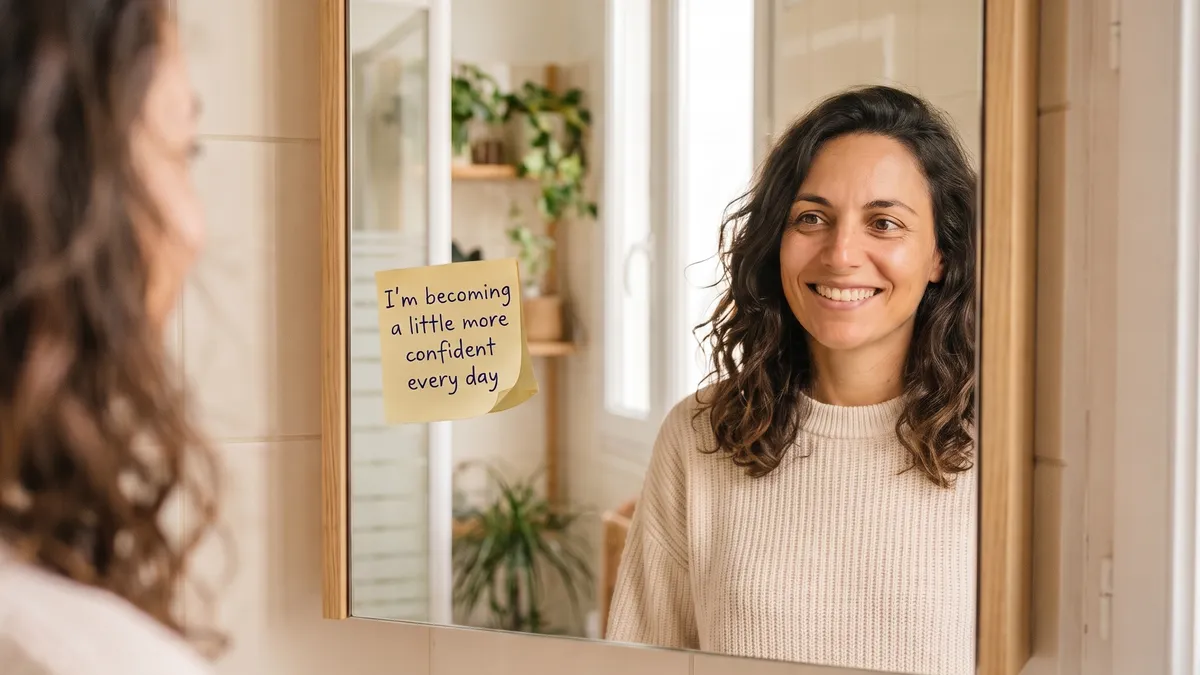
- “I’m becoming a little more confident every day.” “I’m becoming” describes a path; it doesn’t claim you’ve arrived.
- “I learn from every try.” It turns a failure into a lesson, and it stays true even on the day you mess up.
- “I’m allowed to make mistakes and try again.” A permission doesn’t claim anything your brain can argue with, and it works for every theme.
- “My worth stays the same, whether I succeed or not.” It separates who you are from what you do.
- “My needs matter as much as anyone else’s.” The subject is your needs, not you, so it takes on “I have to put myself last” without confronting you head-on.
- “I allow myself to receive what’s good for me.” “I allow myself” is easier to believe than “I deserve,” and it opens the door to the love and money themes.
- “You’ve been through hard times before, and you’re still here.” It rests on a fact of your own life that no one can argue with.
- “Here and now, I can relax.” It’s about this very moment, and lying in bed at night, you can feel that it’s true.
- “Why do I feel more and more like I belong?” A question doesn’t claim anything: your mind looks for answers instead of objecting.
If a word doesn’t sit right, change it: that’s what makes the sentence yours.
Find your belief and reprogram it.
- You describe what holds you back
- The app writes your affirmations
- You record them in your voice
- You listen at bedtime
7 days free, no commitment
90 positive affirmations, by theme
These examples of positive affirmations follow the app’s 9 themes, each aimed at a limiting belief, a sentence you tell yourself about yourself that holds you back. They mix forms: “I,” “you,” questions, and sometimes a subject other than you.
Self-esteem
These self-love affirmations target “I’m not enough.” If a sentence feels like too big a leap, pick one that describes progress instead, like number 4.
- You are enough, exactly as you are.
- I’m gentle with every part of myself.
- Why do I feel like I belong here?
- I’m growing a little prouder of myself every day.
- I’m learning to let people see me, bit by bit.
- My worth comes before my results.
- You can talk to yourself the way you’d talk to someone you love.
- I treat myself with the respect I give others.
- My flaws are part of me, and I still belong.
- How can I be a little kinder to myself today?
Self-confidence
These target “I won’t be able to do it.” To understand what feeds this doubt, see where self-confidence comes from.
- You’re getting there, one step at a time.
- Why do I feel I have every right to be here?
- My path has value, just as it is.
- I go for it, even with butterflies.
- I allow myself to take up space.
- I can have doubts and still move forward.
- You’ve already made it through things you thought you couldn’t handle.
- My opinion counts, even when it’s different.
- I trust myself to make the next small decision.
- A mistake teaches you something, and you’re still just as capable.
Worthiness
These target “I don’t deserve it,” and your self-worth: your right to let good things in.
- I deserve what’s good for me.
- You deserve kindness, just for being you.
- Happiness is for me too.
- I’m learning to receive with gratitude.
- Why do I feel like I matter too?
- I can rest even before everything’s done.
- You can take a compliment without rushing to give one back.
- My needs matter.
- I can enjoy life without having to earn it first.
- Taking care of myself takes nothing away from anyone else.
Love and relationships
These target “I’m not worthy of love,” and the fear that everyone ends up leaving.
- I let myself be loved.
- I’m learning to build relationships that last.
- Why do I feel free to be myself?
- You can show who you really are.
- I can count on myself, and on others.
- I’m finding the courage to say what I need.
- You can set a boundary, even with someone you love.
- I can disagree and still be myself.
- I choose people who treat me well.
- How can I let someone I trust a little closer today?
Safety and letting go
These target “I have to control everything,” and the need to plan for every possibility. The sorting that helps loosen this need is explained on the page about letting go of what isn’t up to you.
- I am safe, here and now.
- You do your part, and you let go of the rest.
- I let go a little, and everything still holds.
- Some people deserve my trust.
- Why do I keep noticing what’s going right?
- I can move forward without knowing what comes next.
- My body can relax, right here, right now.
- You can ask for help and still be in charge.
- The unexpected happens, and I know how to adapt.
- Tonight, I set aside whatever can wait until tomorrow.
Money
These money affirmations target “There’s never enough.” They’re about your relationship with money, not a promise of any amount.
- There’s enough, for me too.
- You deserve to prosper.
- Money can support what matters to me.
- I deserve my money, even when it comes easily.
- Why is asking for money getting easier for me?
- I’m getting comfortable charging a fair price for my work.
- I check my bank balance calmly.
- You’re allowed to talk about money without shame.
- Managing money is something you can learn, at any age.
- I can earn a good living and stay true to my roots.
Success
These target “I’m going to fail” and “I’m going to be found out.”
- I keep going, and I learn from every try.
- My skills are real, and so is my place here.
- You’ve earned what you’ve built.
- Why am I succeeding in my own way?
- Every small step brings me closer to my goal.
- I can aim high and stay true to myself.
- A failure is one attempt, not a verdict on my worth.
- You can step into the spotlight when your work deserves it.
- There’s still time for what matters to me.
- I finish what I start, one step at a time.
Health and body
These target “I don’t like my body.” They’re about your relationship with your body; for your health itself, your doctor’s advice comes first.
- My body carries me, day after day.
- I’m starting to appreciate my body.
- You and your body are a team.
- I make time for myself, every day.
- Why do I enjoy moving my body more and more?
- I notice when my body is tired.
- You can thank your body for what it’s doing for you today.
- I take care of myself in small ways.
- Rest is part of staying healthy.
- My body deserves kindness, at any age.
Meaning
These target “My life has no meaning.”
- I’m finding my life’s meaning, step by step.
- You have something to offer the world.
- Why do I still see the beauty around me?
- I am part of something bigger.
- I reach out to people who understand me.
- A small gesture today can mean something to someone.
- I can keep searching, even if I don’t have answers yet.
- You can go after what you care about most.
- My values show me the next step.
- What truly matters to me today?
Daily affirmations: what to say in the morning and at night
In the morning, choose a sentence that sets a goal within reach, like “Today, I take one step, and it counts.” At night, choose one that gives you permission to stop, like “What I did today is enough for today.” Morning affirmations look at the day ahead; bedtime ones help you let go of whatever’s left.
Five for the morning
- Today, I take one step, and it counts.
- I choose what matters to me today.
- Every day, I feel a little more capable.
- You have what you need for today.
- Why do I feel so ready for today?
They aim small on purpose, so your day can prove them right.
Five for the night
- What I did today is enough for today.
- You can let the day go now; it’s over.
- My body can rest, even if sleep takes its time.
- I think back to one thing that went well today.
- Why do I fall asleep more and more easily?
They let you stop and turn your mind toward what went well.
How do you use positive affirmations?
Our advice: a few sentences your brain can believe, said out loud at the same time every day, ideally when you wake up or at bedtime. It comes down to five steps and a few minutes a day, with a notebook or an app that records your sentences.
- Pick 3 to 5. A handful is easy to remember when you’re starting out on your own.
- Run our believability test. Say the sentence and ask yourself, “Can I believe this, even a little, today?” Your brain isn’t easily fooled. If the sentence contradicts what you feel deep down, the words slide right off. But it can accept progress: “I’m confident” becomes “I’m becoming a little more confident every day.”
- Say it out loud, so you can hear yourself. Coué wanted his formula spoken, not just thought; moving your lips, he insisted, is “indispensable.”
- Keep the same time every day, when you wake up or at bedtime. Coué chose these same two moments, and Murphy sees them as the best times to speak to your subconscious mind. If you do it with your eyes closed and your body relaxed, the practice comes close to self-hypnosis at home.
- Stick with it, even after a missed day. In a study by Lally and colleagues (2010), based on 39 of the 96 volunteers they followed for 12 weeks, a simple action like drinking a glass of water became automatic after a median of 66 days (half took less). The time it took ranged from 18 to 254 days depending on the person, with the longest times estimated by extrapolation. Missing a single day barely mattered. How long it takes to form a habit varies that much, so treat 66 days as a rough guide, not a deadline.
How do you write your own affirmations?
Start with your belief: write down the sentence you actually tell yourself, then the one you could say instead, one notch further, without jumping straight to its opposite. “I’m useless” rarely becomes “I’m brilliant”; it can become “I learn from every try,” a sentence about learning that your brain can accept.
To find your starting sentence, browse the full list of limiting beliefs, 124 sentences sorted by theme, or fill out a core beliefs worksheet.
| Your belief | Too far to believe | Within reach |
|---|---|---|
| “I’m going to fail” | “I succeed at everything I do” | “I keep going, and I learn from every try” |
| “I don’t deserve to be loved” | “Everyone adores me” | “Little by little, I’m letting myself be loved” |
| “I don’t know how to manage money” | “Money flows to me effortlessly” | “I’m learning to manage my money a little better every month” |
| “It’s too late for me” | “Anything is still possible for me” | “Every small step brings me closer to what matters” |
The sentences on the right each have a verb of movement, a permission, or a “little by little.” They describe a path your brain can see for itself, rather than a state it would argue with.
The authors who inspired HypnoSelf point in the same direction. Murphy reports that many people who kept saying they were wealthy and prosperous felt they were lying to themselves; to a struggling businessman, he suggested repeating that his sales were improving every day.
In HypnoSelf, a written conversation with an AI assistant helps you name the sentence that holds you back, then the app turns it into sentences that describe progress. You can try the conversation for free.
“I am” affirmations, “you,” or a question: why mix them?
“I am” and other first-person sentences anchor the affirmation in your identity. “You” talks to you the way you’d talk to someone you’re supporting, and helps you step back. A question sidesteps the objection, because your mind looks for an answer. In HypnoSelf, your affirmations mix these forms, sometimes with your first name.
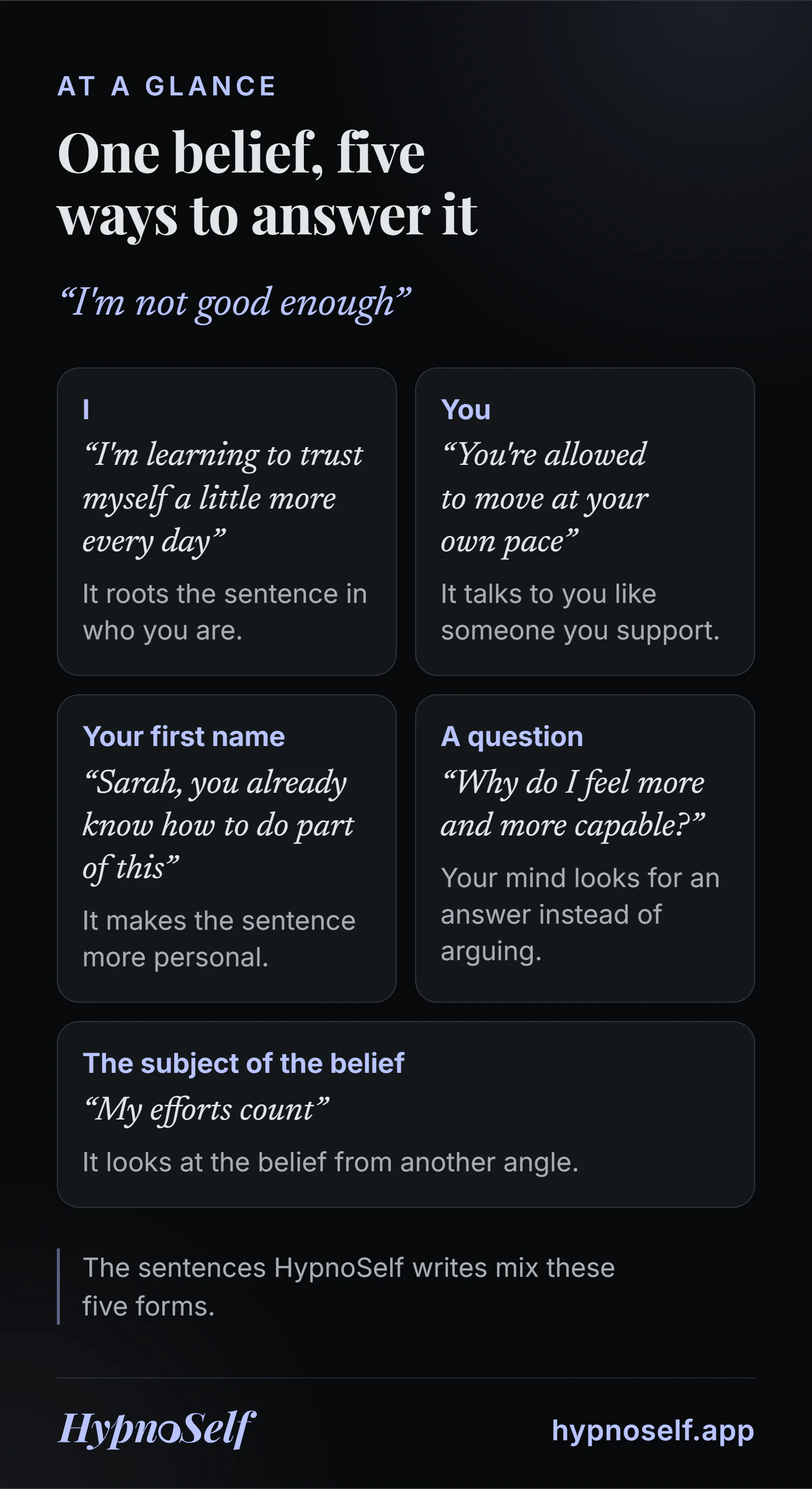
Kross and colleagues (2014) tested, across 7 studies and 585 participants, what happens when people refer to themselves as “you” or by name before a stressful task, such as giving a speech: compared with those who said “I,” they felt less distress and dwelled less on it afterward.
Positive questions, or afformations
“I am confident,” said on a day when you’re not, can trigger an instant objection. “Why do I feel more confident every day?” meets less resistance: the question doesn’t claim anything, and according to author Noah St. John, your mind starts looking for answers. He called these questions “afformations” (The Book of Afformations, 2013).
A small lab study backs this up. Senay, Albarracín and Noguchi (2010) had students write “Will I” or “I will” 20 times: those who had written the question went on to solve more anagrams. Across four experiments with about fifty students each, the question also strengthened their intention to exercise. The takeaway: a question can motivate more than a statement.
Why listen to your own voice?
When it comes to memory, a study using word lists found a clear ranking: words you say out loud are remembered best, then words you hear again in your own recorded voice, then words someone else reads (Forrin and MacLeod, 2017). Recording your sentences and listening back combines the first two.
Why listen to your own voice rather than someone else’s? Two authors who inspired HypnoSelf were already leaning that way. Coué had people repeat his formula “in a monotonous voice,” moving their lips. Joe Dispenza suggests recording yourself reading the script of his meditations and listening to it afterward.
Do positive affirmations really work?
They can help, especially when the sentence is believable. Repeated in front of the mirror, a generic affirmation is only a first step: according to Bruce Lipton and Joe Dispenza, what counts happens in the subconscious, where our automatic reactions live. That’s why it pays to start with your belief and pick your moment.
What two experiments measured
Wood, Perunovic and Lee (2009) had students repeat a ready-made sentence, “I am a lovable person,” during a single session. Mood improved slightly for those with high self-esteem; for those with low self-esteem, it ended up worse than for people who repeated nothing. Flynn and Bordieri (2020) repeated the experiment with about 225 people in a university setting and found no difference, whatever their self-esteem. That’s the whole debate behind the question: do affirmations work?
What we take from it. When in doubt, choose sentences that describe progress. Your brain finds them plausible, so they don’t trigger an unconscious objection: “I’m learning to accept the affection people show me” rather than “I am a lovable person.” That’s how HypnoSelf builds your sentences.
Conscious, subconscious: the belief and the moment
Bruce Lipton argues on his website that the conscious mind counts for only about 5% next to the subconscious mind’s automatic programs, and, in The Biology of Belief, that a positive affirmation fails when it contradicts what you were told over and over as a child. In other words, a sentence repeated in front of the mirror gets stuck in the filter of the conscious mind. That’s why HypnoSelf makes two choices: start with your belief, which the conversation helps you name, and listen to your affirmations as you fall asleep and wake up. At those moments, the brain changes rhythm, and that has been measured (see what the research measures). The idea that your subconscious is more receptive then comes from the authors. Murphy places the best time to impress your subconscious “prior to sleep and just after we awaken.” In You Are the Placebo, Dispenza says much the same of those two moments: “the door to the subconscious mind is open during these two times.”
If you’ve repeated affirmations before without feeling anything, the most useful next step is to start by finding your belief with the conversation.
Where do affirmations come from? Coué and autosuggestion
Affirmations descend from autosuggestion, described a century ago by Émile Coué, a French pharmacist (Britannica). His formula became famous in America in the 1920s: “Every day, in every way, I’m getting better and better.”
The 1922 American translation of his book, Self Mastery Through Conscious Autosuggestion, words it “Every day, in every respect, I am getting better and better.” It’s the same phrase for everyone: Coué found this general suggestion “more efficacious than special ones.”
He defines autosuggestion as “the implanting of an idea in oneself by oneself.” He sums up its principle this way: “When the will and the imagination are antagonistic, it is always the imagination which wins.” His example is a plank 30 feet long and 1 foot wide. Lay it on the ground and anyone can walk along it; put it up at the height of a cathedral’s towers, he writes, and you would fall “in spite of every effort of your will,” because you imagine you can’t make it. That’s why, in his view, you repeat the formula without forcing it.
His ritual: every morning before you get up and every evening as soon as you’re in bed, close your eyes and repeat the phrase twenty times, moving your lips. You count on a string tied with twenty knots, like a rosary, so the recitation stays mechanical. He asks you to do it “as long as you live” and “without effort.”
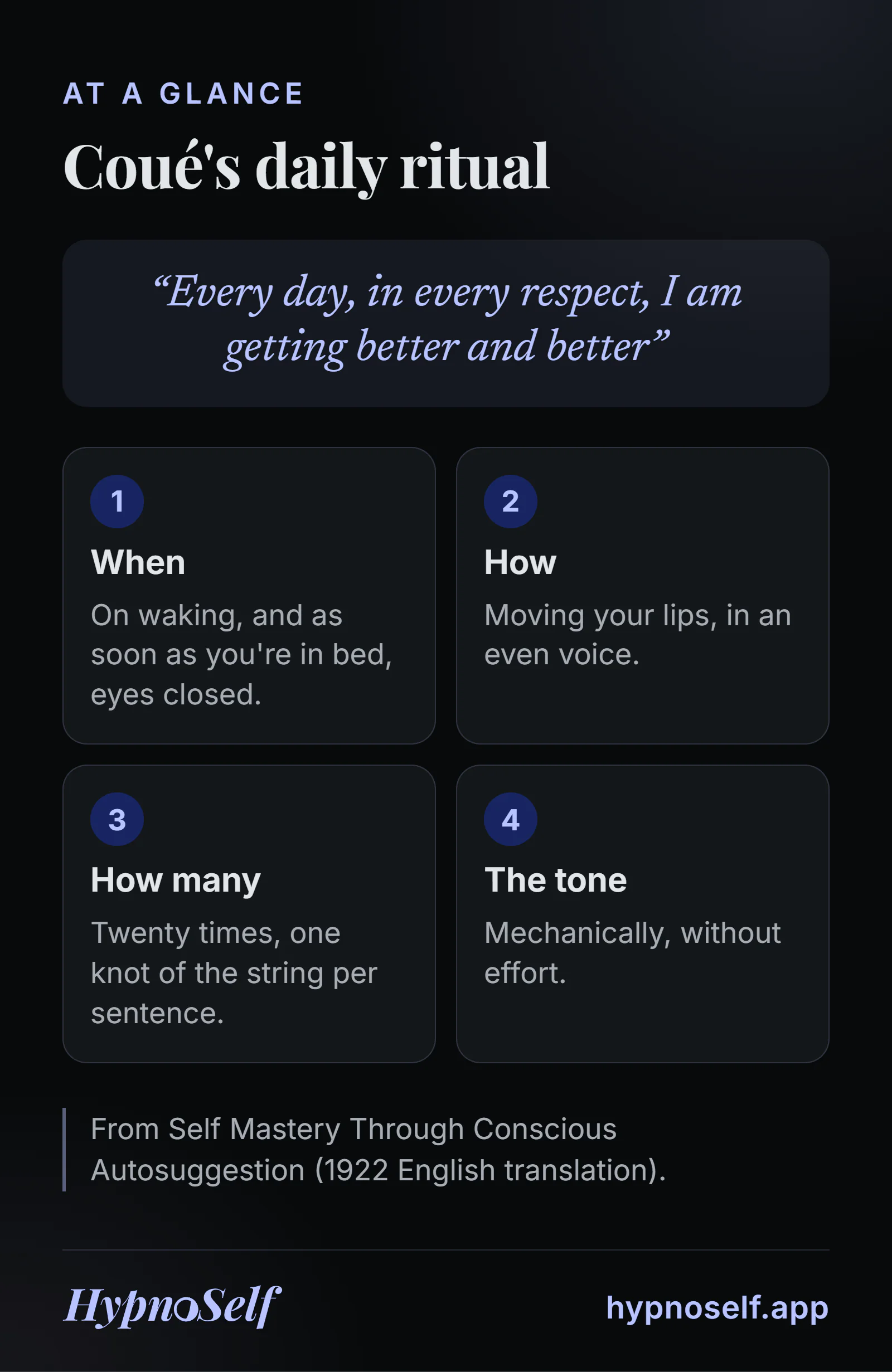
HypnoSelf keeps his two moments of the day, the daily repetition and the idea that it shouldn’t take effort.
Affirmations, positive thinking, mantras, autosuggestion: what's the difference?
A positive affirmation is a sentence about you, chosen for what you’re working toward. Positive thinking is a general attitude, a positive mantra a set phrase repeated word for word, and Coué’s autosuggestion a single phrase, the same for everyone, said morning and night.
| Practice | What it is | Example | What sets it apart |
|---|---|---|---|
| Positive affirmation | A short sentence about yourself, in the present tense | “I learn from every try” | Targets a specific belief and varies from person to person |
| Positive thinking | An attitude: looking on the bright side | “It’s going to be OK” | No set sentence, no set time |
| Positive mantra | A short phrase repeated word for word; the word comes from Sanskrit | “One step at a time” | Mostly used to focus attention |
| Autosuggestion (the Coué method) | Self-suggestion as described by Émile Coué around 1920 | “Every day, in every way, I’m getting better and better” | One formula, 20 times on waking and at bedtime |
What positive affirmations can't fix
A positive affirmation works on what you tell yourself. It supports action but doesn’t replace it: “I’m getting comfortable charging a fair price for my work” takes on real meaning the day you actually name your price. It isn’t a cure, either. And it takes time: Coué himself called it a mistake to expect suggestion to work overnight, and wrote that “it is no use expecting from suggestion more than it can normally produce.”
HypnoSelf supports the work you do on yourself; it doesn’t replace help from a health professional. If you’re going through a hard time, here’s who you can turn to.
Affirmations written for you, in your voice
The sentences on this page are starting points; the ones that really count begin with your belief, in your own words. Coué gave everyone the same formula; HypnoSelf adds personalization, in three steps.
Find your belief. The conversation with an AI assistant starts with what you share and digs down to the belief that holds you back.
Get targeted affirmations. The app writes 25 to 30 sentences built around that belief and your situation, in line with your values and in words you’d actually use, mixing the forms you’ve seen on this page with sentences that describe progress. When a direct sentence meets resistance, it offers a gentler bridge sentence.
Listen to them in your voice, at the right time. You record them over background sound, then listen at night as you fall asleep or in the morning as you wake up, with a sleep timer.
Say, for example, that you’re always afraid the person you love will end up getting tired of you. The app might write “I’m learning to feel safe in love,” “[Your name], you’re letting yourself be loved a little more every day,” or “Why do I feel more and more secure with the person I love?”
Start the conversation. The conversation, your affirmations and your recording are free, no credit card needed. Listening then requires a card: it starts a 7-day free trial, cancel anytime before it ends, then a subscription.
Frequently asked questions
What are 5 affirmations to say every morning?
Five affirmations to say every morning: “Today, I take one step, and it counts,” “I choose what matters to me today,” “Every day, I feel a little more capable,” “You have what you need for today,” and “Why do I feel so ready for today?” They aim small on purpose, so they stay believable.
What are good affirmations to say before sleep?
At bedtime, a simple sentence works well, such as “What I did today is enough for today”: it puts the day to rest and stays easy to believe when you’re tired. A question is another option, since your mind then looks for an answer instead of replaying the day: “Why do I fall asleep more and more easily?”
What are three affirmations to say every day?
Three affirmations that stay believable even on a hard day: Émile Coué’s “Every day, in every way, I’m getting better and better,” which describes progress; “I learn from every try,” which turns a mistake into a lesson; and “I’m allowed to make mistakes and try again,” a permission your brain has no reason to argue with.
Can I record affirmations in my own voice?
Yes, and memory research points that way: in a word-list study (Forrin and MacLeod, 2017), people remembered words they heard again in their own recorded voice better than words read by someone else. In HypnoSelf, you record the affirmations the app wrote for you, over background sound, then listen at bedtime or when you wake up.
What are daily affirmations?
Daily affirmations are short, positive sentences you repeat every day, ideally at the same time, when you wake up or at bedtime. Our advice: choose 3 to 5 you can believe, often ones that describe progress, and say them out loud or listen to them. For a simple action, Lally’s 2010 study found a median of 66 days before it became automatic.
HypnoSelf is an app for affirmations written from your own words, which you record in your own voice and listen to when you wake up and as you fall asleep. This page was written by the HypnoSelf team.