Imposter syndrome: when you think you owe it all to luck
By HypnoSelf · updated November 16, 2026

Imposter syndrome is the feeling that you owe your successes to luck or to a mistake, and the fear of being found out one day. First described in 1978, this doubt isn’t a mental illness. It undermines your self-confidence, and you can chip away at it step by step, starting with how you take a compliment.
In short
- Two psychologists, Clance and Imes (1978), named the phenomenon after observing more than 150 high-achieving women, both students and professionals, who were convinced they owed their success to luck or to a mistake.
- How many people have it varies with how you measure it: from 9% to 82% of those surveyed, depending on the questionnaire and the cutoff score (Bravata and colleagues, 2020, a review of 62 studies).
- HypnoSelf, an affirmations app, starts with a conversation to find the sentence hidden behind your “I just got lucky.” It then writes sentences that answer it, for you to record in your own voice and play at bedtime or first thing in the morning.
| Key point | Value |
|---|---|
| What it is | a phenomenon described in 1978, not a diagnosis |
| The clearest sign | crediting your successes to luck and fearing you’ll be found out |
| How many people | 9% to 82%, depending on the questionnaire and the cutoff (Bravata, 2020) |
Contents
What is imposter syndrome?
It’s the nagging sense that you’ve fooled everyone: you chalk up your real achievements to luck or to other people’s kindness, and you’re afraid someone will eventually notice. The two researchers who described it called it the imposter phenomenon and never treated it as a diagnosis.
Yasmine has worked in logistics for a chain of sporting goods stores for six years. She was just promoted to team manager, chosen over two candidates from other companies. On Saturday night, at her friend Allison’s, everyone raises a glass to her promotion. Yasmine smiles. “I mostly got lucky. They didn’t have anyone else.” Her boyfriend, Nicolas, brings up the other two candidates; she changes the subject. In her head, another sentence keeps playing: “I’m not up to the job, and sooner or later they’ll figure it out.”
The term comes from American psychologists Pauline Clance and Suzanne Imes (1978). Over five years of individual therapy, therapy groups and classes, they worked with more than 150 women aged 20 to 45, from college students to university faculty, who didn’t feel worthy of their own success. A good grade? Luck. A university teaching job? A mistake in the selection process, according to one of them. The women dreaded being found out one day. These are therapists’ observations, with no comparison group and no measure of how common the phenomenon is.
Yasmine’s “they didn’t have anyone else” is the same kind of explanation as that academic’s selection mistake: it ignores a fact, in her case the two other candidates.
What are the signs of imposter syndrome?
The clearest sign is that a compliment makes you uncomfortable and you immediately hand the credit to luck or to other people. The other signs grow out of the fear of being found out. What matters is that they keep coming back. Feeling nervous once before a big day isn’t a sign.
- At work, you avoid asking for help, in case people see what you don’t know.
- Before a deadline, you overprepare, or you put things off until the last minute, a form of self-sabotage.
- In your relationship, you wonder what your partner sees in you, a fear that can lead to self-sabotage in relationships.
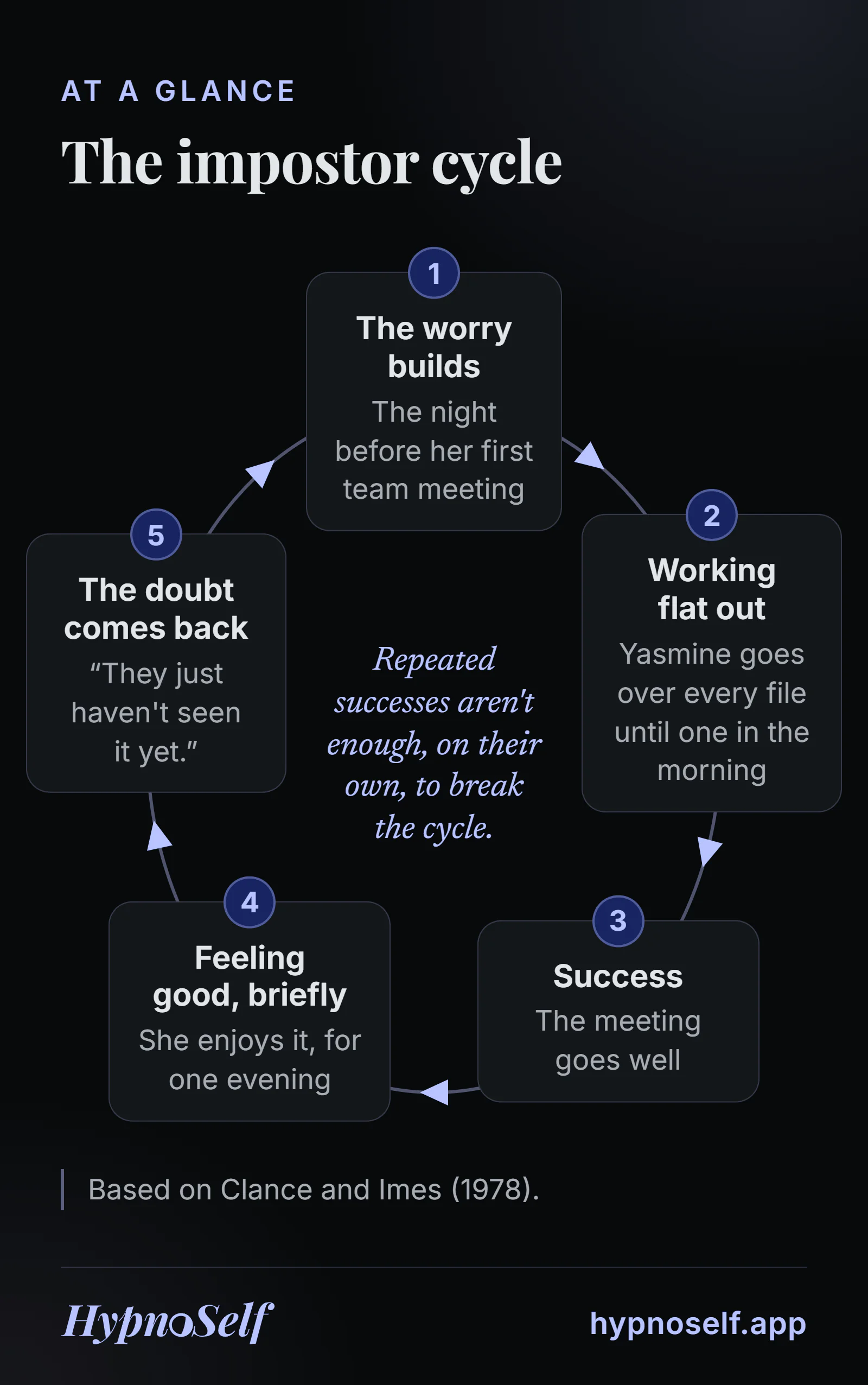
Clance and Imes describe the cycle that keeps this doubt going: worry drives you to work flat out, the work brings success, success makes you feel good, briefly, and then the doubt comes back. In their experience, repeated successes weren’t enough, on their own, to break the cycle.
The night before her first team meeting, Yasmine goes over every file until one in the morning: that’s working flat out. The meeting goes well, and she enjoys it for one evening: feeling good, briefly. Then the thought comes back: “They just haven’t seen it yet.” Success leaves her belief, “I’m not up to the job,” untouched, and that belief is what she’ll need to work on.
Unlike a lack of confidence, where you hesitate to get started, imposter syndrome shows up once you’ve already succeeded: what’s off is the way you explain that success.
Find your belief and reprogram it.
- You describe what holds you back
- The app writes your affirmations
- You record them in your voice
- You listen at bedtime
7 days free, no commitment
What are the 5 types of imposter syndrome?
The 5 types come from American author Valerie Young, in her book The Secret Thoughts of Successful Women (2011): the Perfectionist, the Expert, the Natural Genius, the Soloist and the Superhuman. Each one measures competence by a rule that’s too harsh. It’s one author’s classification, meant to help you recognize yourself, not to diagnose anything.
| Type | Its rule | What it would sound like for Yasmine |
|---|---|---|
| The Perfectionist | a single flaw wipes out the success | “One mistake in the schedule and I’m done for.” |
| The Expert | know everything before you act | She rereads every one of her team’s files before she dares to speak up. |
| The Natural Genius | needing effort proves you’re not gifted | “If I have to work this hard, this job is beyond me.” |
| The Soloist | asking for help means admitting you can’t do it | She doesn’t dare call her predecessor for advice. |
| The Superhuman | excel in every role at once | “At work and at home, I have to hold it all together.” |
Yasmine sees herself mostly in the Expert and the Soloist: her doubt strikes before she speaks up and when she needs to ask for help. The Perfectionist type overlaps with perfectionism, which has its own page.
Is there an imposter syndrome test?
The most widely used test is the Clance Impostor Phenomenon Scale, published in 1985: 20 statements about your successes and doubts, each rated from 1 (not at all true for you) to 5 (very true), for a total between 20 and 100. This research questionnaire shows where you stand; it doesn’t make a diagnosis.
Clance reads the total this way: 40 or below means few impostor traits, 41 to 60 moderate ones, 61 to 80 frequent ones, and above 80 intense ones. A review of 18 studies on impostor questionnaires found Clance’s scale the most widely used, but still too little tested to count as the gold standard (Mak, Kleitman and Abbott, 2019).
And the “70%” you often see quoted? A US team pooled 62 studies covering 14,161 people, often students (Bravata and colleagues, 2020): the share of people affected ranged from 9% to 82%, mainly depending on the questionnaire used and the cutoff score at which someone was counted as affected. So a single figure like 70% doesn’t hold up.
For Yasmine, a score would only confirm what she already knows. What matters is what this doubt costs her: evenings spent preparing and compliments she turns away.
How do you overcome imposter syndrome?
To overcome imposter syndrome, this page suggests four steps: notice how you brush off compliments, dig down to the belief behind that reflex, talk to someone you trust, then accept a compliment and, every day, hear a sentence you can believe. Three of them come from Clance and Imes’s own practice.
1. Write down how you brush off each compliment
For a week, write down every compliment, your reply and the facts your reply left out. Clance and Imes gave this as homework: keep track of positive feedback and of how you stop yourself from accepting it. Side by side on the page, these exchanges show how you keep any praise from sticking.
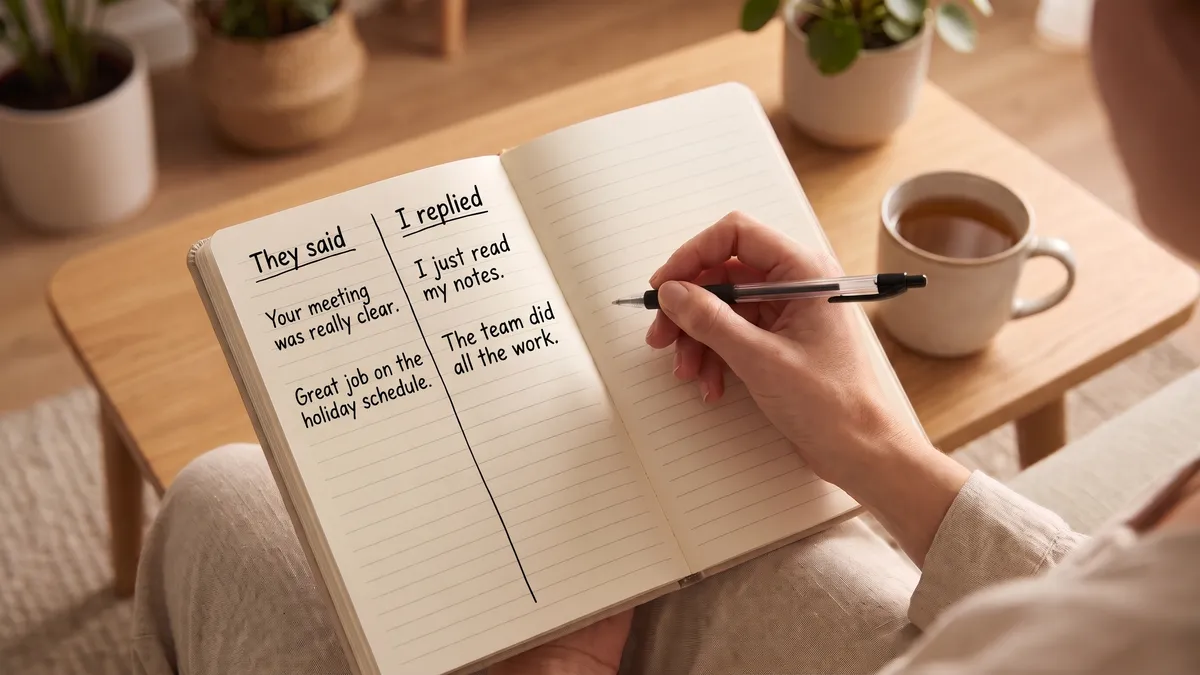
On Monday, a coworker tells Yasmine, “Your meeting was really clear.” She replies, “I just read my notes.” On Thursday, her boss says, “Great job on the holiday schedule.” Yasmine answers, “The team did all the work.” The facts she left out: she had prepared for the meeting, and the schedule was her idea.
2. Dig down to the belief that makes you brush off your successes
Take one compliment you brushed off and ask yourself: “What scared me about accepting it?” Then, after each answer, ask: “And then what would I think of myself?” The last answer is a sentence about yourself. That sentence is your belief, and it’s what makes every success look like a fluke. The core beliefs worksheet has more questions.
What would scare Yasmine about accepting the compliment? “That they’ll expect even more of me.” And then? “I’ll end up letting them down.” And what would she think of herself? “I’m not up to the job, and sooner or later they’ll figure it out.” With that belief, her promotion can only be luck. The HypnoSelf conversation can ask you these questions one by one, all the way down to your belief.
3. Talk about it with someone you trust
Tell someone supportive what you really think about your success, for example your fear of being found out one day. Clance and Imes noticed that the women they worked with kept this doubt secret. In their therapy groups, when one woman dared to admit it, others admitted the same doubt, surprised and relieved to find they weren’t alone. And each woman could see right away that the others were wrong about themselves: the other women’s degrees said the opposite of their doubts.
One Sunday, Yasmine admits to Allison, “I think they made a mistake picking me.” Allison, who became a nurse manager last year, bursts out laughing. “My first year, I waited every morning for someone to tell me it was a mistake.” Allison plays the part of the therapy group here: Yasmine sees right away that her friend’s doubt doesn’t match the facts, and her own starts to feel a little less solid.
4. Accept a compliment, then tell yourself something believable
The next time you get a compliment, do the opposite of what you usually do: listen, say thank you and let it count. That was the next step for Clance and Imes. They also advised taking small steps: giving up overworking all at once, when it has always “worked,” could trigger intense anxiety.
The following Friday, when her boss congratulates her on the inventory count, Yasmine replies, “Thanks, I put a lot of time into it.” The words are hard for her to say, and nobody finds anything wrong with them. She’ll cut back on her late evenings of preparation later, one at a time.
That leaves her belief, “I’m not up to the job.” Flipped into its exact opposite, it would sound false: Yasmine wouldn’t believe “I’m up to the job” for a second. An affirmation that describes progress can get through, because it rests on what she’s actually experiencing: “Every week, I’m learning a job they chose me for.” The app writes yours from your belief, and you lend them your own voice.
When should you get help for imposter syndrome?
When the doubt keeps you up at night or comes with anxiety that lingers, a psychologist can help: in the 2020 review of 62 studies by Bravata and colleagues, the phenomenon often went hand in hand with anxiety or depression. Clance and Imes themselves worked on it in one-on-one sessions and in groups.
HypnoSelf supports personal growth; it doesn’t replace help from a healthcare professional. If you’re going through a hard time, here’s who you can turn to.
Getting over imposter syndrome with HypnoSelf
One evening, in the HypnoSelf conversation, Yasmine describes her night at Allison’s. The AI assistant asks her one question at a time, about the toast, then about what she was afraid of, until it reaches her belief, “I’m not up to the job,” which it rephrases and she confirms. As it happens, “I’m a fraud” is one of the limiting beliefs the conversation uses as reference points.
From that belief, the app writes her 25 to 30 affirmations in several forms, including these:
- “Yasmine, you were chosen over two other candidates, and every week you’re learning your new job.” This sentence starts from a fact Yasmine can’t argue with.
- “Why am I finding it a little easier to accept each compliment?” In author Noah St. John’s view, a question like this one sets your brain looking for an answer rather than arguing back.
- “Little by little, I’m recognizing what I achieve on my own.” It describes a change under way, so it doesn’t ask her to believe it overnight.
When a sentence feels too strong, the app suggests a more gradual one. Yasmine records her sentences by reading them aloud herself, with a background sound picked in the app, then plays them in bed at night; playback stops on its own. Joseph Murphy, an author the app draws on, advised turning to your subconscious mind before you fall asleep, when, in his view, the resistance of the conscious mind is at its lowest.
Next time someone raises a glass to her, Yasmine would like to say “thank you” and leave it at that.
Start the conversation. The conversation, your affirmations and your recording are free, no credit card needed. Listening then requires a card: it starts a 7-day free trial, cancel anytime before it ends, then a subscription.
Frequently asked questions
What causes imposter syndrome?
Pauline Clance and Suzanne Imes, the American psychologists who described imposter syndrome in 1978 after working with more than 150 high-achieving female students and professionals, traced its roots to the family. One example is a daughter labeled “the sensitive one” next to a brother or sister seen as smarter. They also pointed to the stereotype that women are less capable.
Is imposter syndrome a mental illness?
No. Imposter syndrome isn’t listed in the DSM, the diagnostic manual of the American Psychiatric Association, or in the International Classification of Diseases, as a 2020 review of 62 studies points out. The term describes doubt about your own achievements, something a psychologist can help with when it weighs on you.
Is imposter syndrome more common in women?
Clance and Imes described imposter syndrome in women and thought it was less common in men. Since then, the findings have been mixed: of 33 studies that compared men and women, 16 found higher rates in women and 17 found no difference, according to a 2020 review of 62 studies.
What is the opposite of imposter syndrome?
The Dunning-Kruger effect is often named as its opposite. In four studies published in 1999, Justin Kruger and David Dunning found that the students who did worst on tests of grammar or logic greatly overestimated their scores. Imposter syndrome describes the reverse gap: people who succeed and still doubt themselves.
HypnoSelf is an app for affirmations written from your own words, recorded in your own voice and heard as you wake up and fall asleep. This page was written by the HypnoSelf team.