Find your limiting beliefs: a core beliefs worksheet in 5 steps
By HypnoSelf · updated November 14, 2026

To identify a limiting belief, start with one specific situation, write down what you told yourself in the moment, then keep asking “if that’s true, what does it say about me?” until you reach a general statement. This core beliefs worksheet combines two cognitive therapy tools, and the HypnoSelf conversation follows the same logic.
In short
- A limiting belief is a general statement you take as true, about yourself or the world, that limits what you dare to do.
- To find yours, start with a specific moment and ask several times what it says about you: that’s the downward arrow, a cognitive therapy technique.
- According to biologist Bruce Lipton, a positive affirmation fails when it contradicts something programmed in childhood: knowing your belief helps you choose the right sentences.
- HypnoSelf, an app for affirmations recorded in your own voice, helps you find your belief through a conversation, then writes sentences aimed at it.
| Key point | Value |
|---|---|
| What you need | a sheet of paper and 10 to 15 minutes |
| Steps | 5: situation, feelings, the thought in the moment, digging down, hypothesis |
| With HypnoSelf | the conversation finds your belief, the app writes your sentences, you record them |
Contents
How do you identify limiting beliefs, step by step?
The method takes five steps, on a single sheet of paper: a specific situation, what you felt and did, the sentence that came to you in the moment, what that sentence says about you, then a written hypothesis. It brings together two tools from Aaron Beck’s cognitive therapy, in which the sentence that comes to you in the moment, called an automatic thought, grows out of a more general belief (Beck and Haigh, 2014).
Let’s follow one example through every step. Take Sarah. On Saturday, her partner asks what would make her happy for her birthday. She says “nothing, save your money,” even though she has something in mind. She feels embarrassed without quite knowing why.
1. Pick a specific, recent situation
Start with a specific moment, with a day, a place and a scene: that’s what you’re going to take apart. A generalization like “I’m bad at receiving” can’t be taken apart; a scene can.
Choose a situation that bothered you without shaking you to the core: rate it from 0 (no discomfort at all) to 10 (the worst moment of your life), and aim for about 4 or 5. Too trivial, and it won’t teach you much; too painful, and it’s hard to look at on your own.
Sarah writes: “On Saturday, my partner asked what would make me happy for my birthday. I said ‘nothing, save your money,’ even though I had something in mind.”
2. Write down what you felt and what you did
Write one word for the emotion, rate how strong it was from 0 (barely there) to 10 (overwhelming), and note what you did. These details help you recall the scene as it actually happened, not as you’d retell it afterward.
Sarah writes: “Embarrassed, 5 out of 10. I changed the subject.”
3. Find the sentence that went through your head
Ask yourself: “What was going through my mind right then?” Write the sentence down exactly as it came, even if it sounds over the top. These first three steps make up what cognitive therapy calls a thought record.
Sarah writes: “If I ask for something, he’ll think I’m asking too much.”
4. Dig down to what that sentence says about you
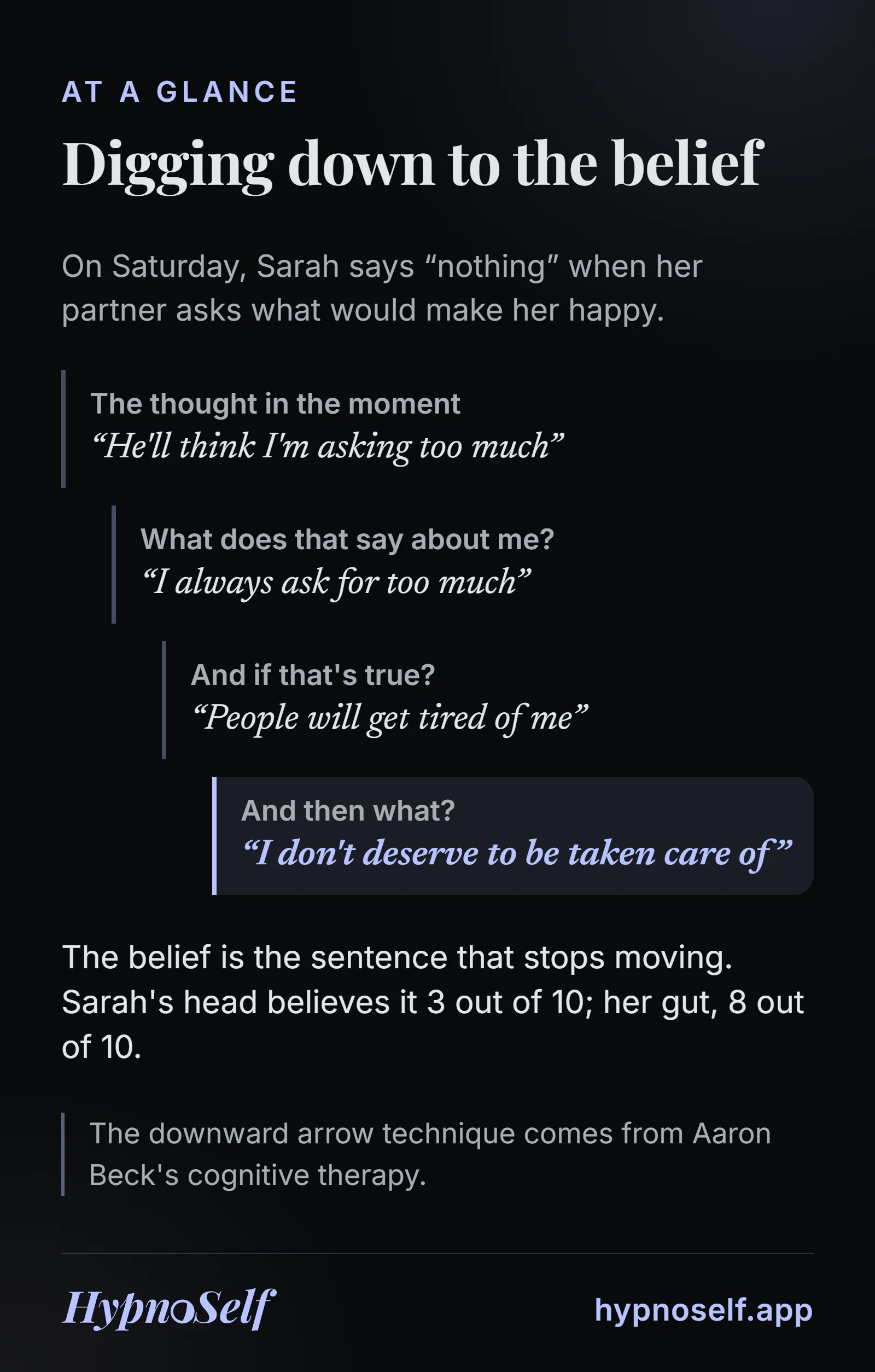
The thought in the moment is about the situation; the belief, deeper down, is about you. To reach it, ask: “If that’s true, what does it say about me?” Then ask the same question about your answer, or a variation (“And if that’s true?”, “And then what?”), and keep going until the answer stops changing. Stop sooner if it gets too heavy. This is the downward arrow technique, which psychologist Amy Wenzel (2012) traces back to Aaron Beck and his colleagues in 1979.
Sarah gets there in three questions: “he’ll think I’m asking too much” → “I always ask for too much” → “people will get tired of me” → “I don’t deserve to be taken care of.” When she asks a fourth time, nothing new comes up: she’s gotten to the bottom of it.
5. Write a hypothesis, then check it
Write down what you found as a hypothesis: “Maybe I believe that…” It isn’t a certainty yet, just a lead.
Then give it two ratings from 0 (not at all) to 10 (completely). The first is how much your head believes it when you think it over calmly. The second is how much your gut believes it: how true the sentence feels when the scene is actually happening. The two are often far apart, and that’s normal: you can know a sentence is false and still feel it’s true.
Sarah writes: “Maybe I believe that I don’t deserve to be taken care of. Head: 3 out of 10. Gut: 8 out of 10.” In other words, when she thinks about it, she knows it isn’t true; but on Saturday, facing her partner, it felt true.
Finally, test your lead over the next week: if the same sentence comes back in two other situations, you’ve probably found your belief. On Wednesday, Sarah’s sister still owes her $200, and Sarah doesn’t dare bring it up: same sentence, so the lead holds up.
What questions help you uncover a limiting belief?
Stuck on a step? A few questions can get you moving. The first two help you dig down (step 4) when “what does it say about me?” draws a blank; the next two test your lead (step 5). Answer in writing, in whatever words come to you. Here’s how Sarah answers them:
| You want to | The question | Sarah’s answer |
|---|---|---|
| Dig deeper | “If that were true, what would be so bad about it?” | “He’d end up getting tired of me.” |
| Find the rule you follow | “What rule was I following: if I…, then…?” | “If I ask for something for myself, then I become a burden.” |
| See what it costs you | “What does this sentence stop me from doing?” | “Saying what would make me happy, and asking for what I’m owed.” |
| Check that it shows up elsewhere | “Do I tell myself this anywhere else: in my relationships, with money, at work?” | “Yes, with my sister, who owes me $200.” |
The first two come from cognitive therapy; the last two tell you whether a lead is worth working on.
If you’d rather be asked than ask yourself, let the HypnoSelf conversation walk you through these questions: it starts with what you tell it, digs down to your belief, then sums it up so you can confirm it.
Find your belief and reprogram it.
- You describe what holds you back
- The app writes your affirmations
- You record them in your voice
- You listen at bedtime
7 days free, no commitment
What does a completed core beliefs worksheet look like?
Here’s Sarah’s completed worksheet: this is what you’ll have at the end of the exercise. It starts with the “nothing” she said to her partner, goes down in three questions from “he’ll think I’m asking too much” to “I don’t deserve to be taken care of,” and turns up the same sentence again on Wednesday, about money.
| Step | What Sarah writes |
|---|---|
| 1. Situation | On Saturday, my partner asked what would make me happy for my birthday. I said “nothing, save your money,” even though I had something in mind. |
| 2. Feeling, action | Embarrassed, 5 out of 10. I changed the subject. |
| 3. Thought in the moment | “If I ask for something, he’ll think I’m asking too much.” |
| 4. Digging down | What does that say about me? “That I always ask for too much.” And if that’s true? “That people will get tired of me.” And then what? “That I don’t deserve to be taken care of.” And what does that say? “Nothing more.” |
| 5. Hypothesis | Maybe I believe that I don’t deserve to be taken care of. Head: 3 out of 10. Gut: 8 out of 10. |
| Cross-check | On Wednesday, I didn’t dare remind my sister about the $200 she owes me: same sentence. On Friday, I hesitated before a big purchase: that was just being careful. |
By the end, Sarah has a sentence to watch for, and she knows where it shows up: whenever she could ask for something for herself. Her Friday note also shows that not every hesitation is the belief: before a big purchase, hesitating is simply sensible.
What pitfalls should you avoid when identifying core beliefs?
Four pitfalls come up often: mistaking a fact or a real danger for a belief, hunting for a childhood cause, blaming yourself for what you find, and pushing on when the exercise stirs up too much. Each has a way around it.
- Mistaking a fact, or a real danger, for a belief. A fact is something a camera could film, like “I said I didn’t want anything.” “I don’t deserve to be taken care of” isn’t a fact; it’s a conclusion you draw about yourself. Watch out for well-founded fears too, since not every worried thought is a belief to work on. If Sarah thinks “he’ll think I’m asking too much” and her partner really does criticize every request she makes, the problem is no longer in her head but in the relationship, and that’s what she’d need to look at, to talk it through or to step back.
- Hunting for a childhood cause at all costs. It’s tempting to look for the memory that started it all. According to Wenzel, these beliefs often form in childhood, but sometimes in adulthood too, during a time of heavy stress. And you don’t need to know where a belief comes from to spot it: the exercise works from situations you’re dealing with today. Cognitive behavioral therapy (CBT) does the same: according to the American Psychological Association, it focuses mainly on what’s going on in your life now.
- Blaming yourself for what you find. Finding your belief sometimes triggers a second reflex: being angry at yourself for having it. “It’s pathetic that I’m still stuck on this” stacks a second belief on top of the first, and the exercise becomes one more reason to feel bad. That’s why step 5 starts with “maybe”: you look at your sentence as a hypothesis, not a verdict on yourself. Having a limiting belief is common; spotting it is already a step forward.
- Pushing on when it stirs up too much. Writing about what hurts can bring up sadness, anger or memories. A review by Baikie and Wilhelm (2005) looked at expressive writing, which means writing for 15 to 20 minutes about something that affects you deeply. Right afterward, people often feel worse than those who wrote about a neutral topic. The authors see this distress as short-lived and report longer-term benefits, though two studies had unfavorable results: one in adults abused as children, the other in eight veterans. Their advice applies to this exercise too: you can stop at any time and come back later. If what comes up feels very heavy, do this work with a professional.
Why not just repeat the opposite to yourself?
Because your head and your gut don’t believe the same thing. Repeating “I deserve to be taken care of” convinces the part of you that already doubts your belief; the part that believes it pushes back. A sentence that says the exact opposite of what you feel deep down slides off without sinking in.
To put it in HypnoSelf’s terms, Sarah’s head (3 out of 10) is her conscious mind and her gut (8 out of 10) her automatic programs, what Bruce Lipton describes as a subconscious mind far more powerful than the conscious one. According to him, a message heard over and over in childhood undermines any sentence that contradicts it: recited in front of the mirror, “I deserve to be taken care of” stays in her head. That’s why HypnoSelf works in two stages: find your belief, then listen to sentences your gut can accept when your head lets its guard down, as you fall asleep or wake up. Joseph Murphy, Joe Dispenza and the French pharmacist Émile Coué all recommend those two times of day. The first stage is free: the conversation helps you put into words what your gut believes.
What do you do once you've found your belief?
Once you’ve found your belief, you can answer it with sentences you can accept, and hear them every day. That’s HypnoSelf’s job: the conversation helps you name your belief, the app writes sentences aimed at it, and you record them in your own voice and listen to them as you fall asleep or wake up.
The inner cascade
Your beliefs
generate your thoughts.
“I am enough”
Choose the belief at the root
Your thoughts
dictate your emotions and your actions.
“I have the right to be loved just as I am.”
Your actions
shape your behavior.
I say what I feel, I suggest things, I dare to ask.
Your behavior
defines who you are, and the reality you live in.
My relationships become more real, and I feel like I belong.
Change the root (your beliefs) and everything else falls into place.
That's exactly what HypnoSelf makes possible, in four steps and with no effort on your part.
Overcoming your belief takes this kind of work over time; a sentence that shows up everywhere can also point to a repeating pattern. HypnoSelf supports personal growth; it doesn’t replace help from a healthcare professional. If you’re going through a hard time, here’s who you can turn to.
Author Gregg Braden suggests naming your limiting belief, stating its opposite, then backing it up with facts from your own experience: for Sarah, a partner who wanted to make her happy. The HypnoSelf conversation draws on this. With Sarah, it would dig down to “I don’t deserve to be taken care of,” then the app would write 25 to 30 sentences aimed at that belief, using her own words. Each one is a positive affirmation she can accept:
| Sentence | Why it can get through |
|---|---|
| “I’m learning to say what would make me happy.” | It describes progress: her gut (8 out of 10) can go along with it, unlike “I deserve everything I want” |
| “Why is it getting easier for me to let people do nice things for me?” | A question: her brain looks for the times she said yes |
| “Sarah, you’re allowed to ask for what’s yours.” | Her first name and “you” answer “I always ask for too much,” for a gift as much as for her $200 |
| “What I want matters too.” | A fact backs it up: her partner wanted to make her happy |
Where a direct sentence would hit a wall, the app offers an in-between step that’s easier to accept. Sarah records them all in her own voice, over a background track, and listens at bedtime until the sleep timer turns it off.
Start the conversation. The conversation, your affirmations and your recording are free, no credit card needed. Listening then requires a card: it starts a 7-day free trial, cancel anytime before it ends, then a subscription.
Frequently asked questions
How do you identify your limiting beliefs?
To identify your limiting beliefs, start with a recent situation, write down the thought you had in the moment, then ask several times what it would say about you if it were true. That’s the downward arrow technique. Then check the sentence you end up with against other situations in your life.
How do you tell a fact from a limiting belief?
A fact could be filmed: “I didn’t ask for the $200 my sister owes me.” A limiting belief generalizes and judges: “I don’t deserve to be taken care of.” If no fact could ever change your mind about a sentence like that, you’re probably dealing with a belief.
What are the three most common core beliefs?
Psychologist Amy Wenzel describes three typical themes of core beliefs: not being lovable (“I am undesirable”), not being adequate (“I am incompetent”) and being helpless (“I am trapped”). Everyone puts them in their own words, and those words are what this worksheet helps you find.
Is there a test or quiz to identify your limiting beliefs?
Therapists use questionnaires, such as Jeffrey Young’s Schema Questionnaire. Psychologist Amy Wenzel recommends treating their results as hypotheses to be tested, because an important belief may not be on the list. Starting with your own situations, as this worksheet does, gives you your own words.
HypnoSelf is an app for affirmations written from your own words, recorded in your own voice and heard as you wake up and fall asleep. This page was written by the HypnoSelf team.