Do affirmations really work? What the research has measured
By HypnoSelf · updated November 14, 2026
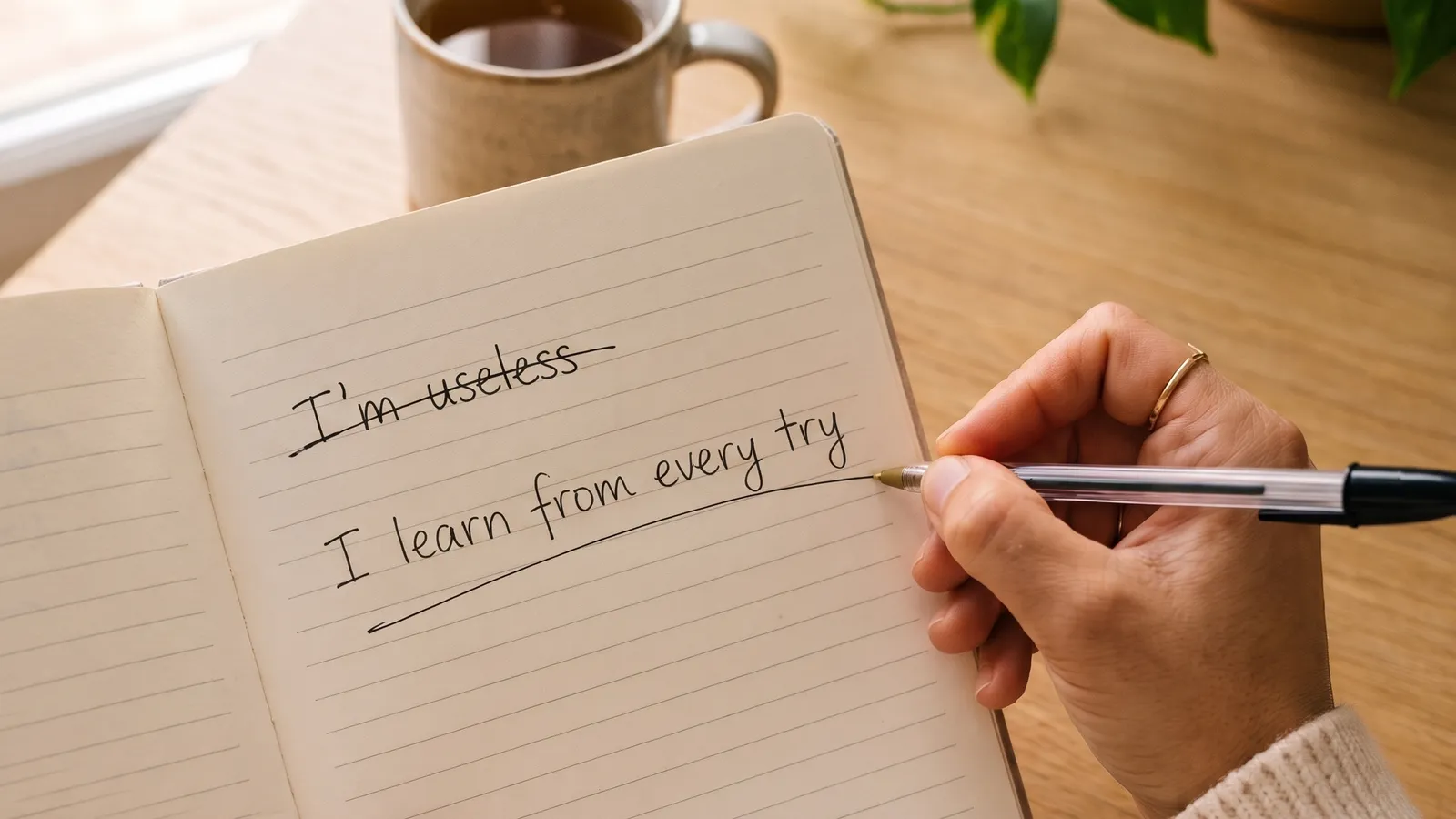
Do affirmations work? For ready-made positive affirmations, the studies are split: in 2009, repeating “I am a lovable person” left students with low self-esteem in a worse mood; when the experiment was run again in 2020, it found no difference. According to the authors HypnoSelf draws on, what counts is a sentence you can believe, heard at the right moment.
In short
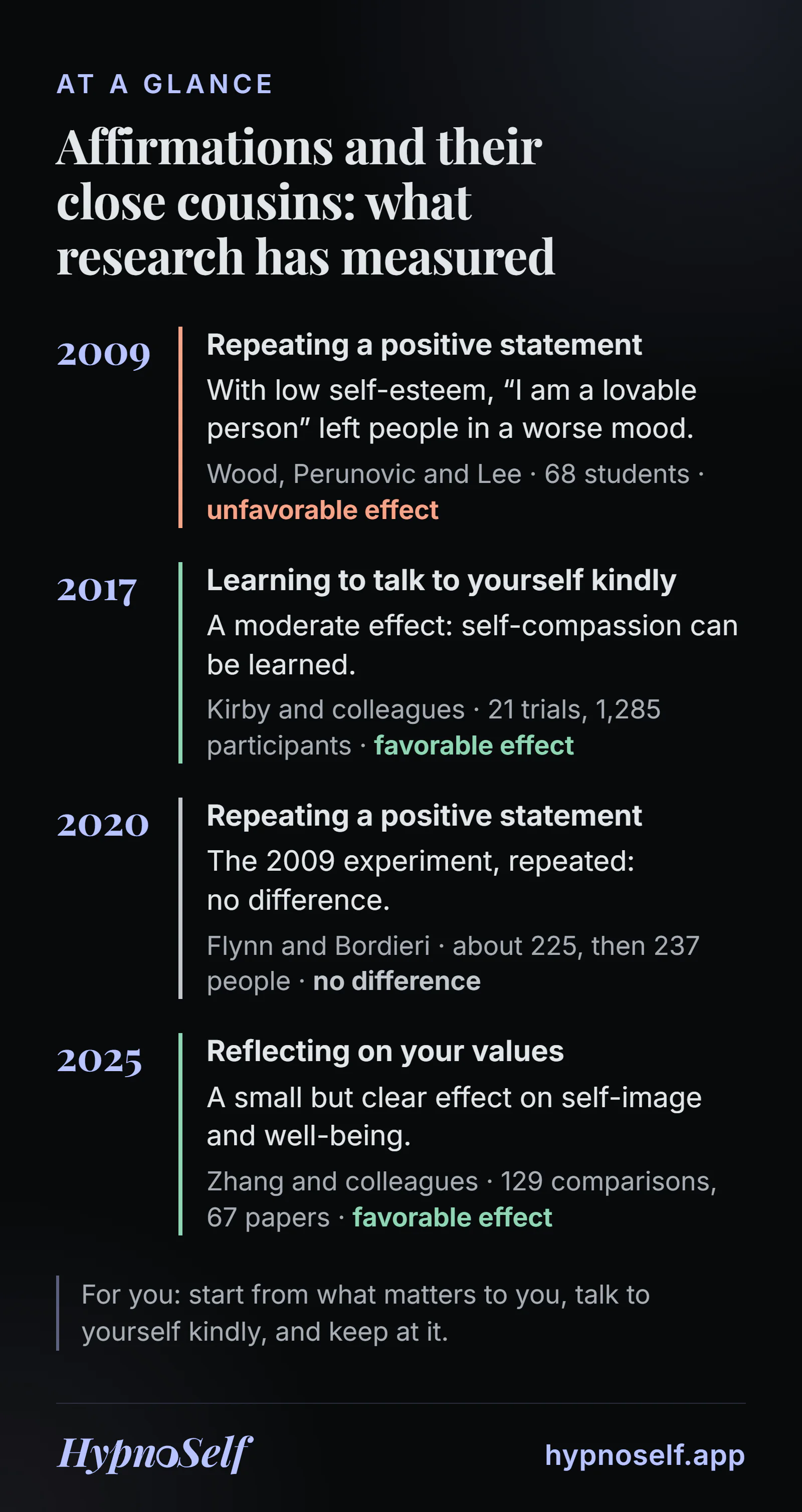
- In 2009, students with low self-esteem who repeated “I am a lovable person” during one session ended up in a worse mood than those who repeated nothing (Wood and colleagues). Run again in 2020 with about 225 people (Flynn and Bordieri), the experiment found no difference.
- A sentence that describes progress, like “I’m becoming a little more confident every day,” clashes less with what you feel than “I’m confident,” which your brain knows is false on a day of doubt.
- According to author Bruce Lipton, an affirmation fails when it contradicts a belief formed in childhood, one that works from the subconscious. So HypnoSelf starts from your own belief and has you listen to your sentences at bedtime or when you wake up.
| Key point | Value |
|---|---|
| The 2009 study | 68, then 116 students, an assigned sentence, one session: a worse mood for those with low self-esteem (Wood, 2009) |
| The 2020 rerun | about 225, then 237 people, no difference (Flynn and Bordieri, 2020) |
| What the authors say | a sentence that contradicts what you believe deep down doesn’t get through (Lipton, Murphy); evening and morning work best (Coué, Murphy, Dispenza) |
| What HypnoSelf takes from it | your belief as the starting point, sentences that describe progress, your own voice, at night or when you wake up |
Contents
Tried affirmations and felt worse?
It happens, and research has documented it. In a survey of 249 students, the lower their self-esteem, the more they said these sentences sometimes made them feel worse (Wood, 2009). According to the researchers, a sentence too far from what you believe about yourself brings its opposite to mind.
The problem probably had less to do with you than with the sentence. The HypnoSelf app was built on these studies and on a handful of authors: you’ll see what it took from them.
What did the 2009 study really show?
In its main experiment, an assigned sentence, repeated 16 times in four minutes, left students with low self-esteem in a worse mood than those who didn’t repeat it. For those with high self-esteem, the benefit stayed small, according to the authors.
Wood, Perunovic and Lee (2009) published three studies:
- A survey of 249 students. Most of them said they used these sentences and found them fairly helpful.
- An experiment with 68 psychology students, chosen from the highest and lowest scorers on a self-esteem questionnaire. All of them write down whatever comes to mind for four minutes; half of them also repeat “I am a lovable person” every time a tone sounds. Mood is measured indirectly. For those with low self-esteem, results are worse than without the sentence on two of the three measures; for those with high self-esteem, better on just one.
- An online experiment with 116 students, with no “no sentence” group. Some think only about what makes the sentence true, others also about what could make it false. Among those with low self-esteem, thinking only about what’s true leaves them in a worse mood than thinking about both.
What this study doesn’t tell you
- It’s small: 68 people split into four groups, about 17 per group.
- The sentence was assigned, the same for everyone: it says nothing about a sentence you’d write yourself.
- There was only one session, measured right afterward: it says nothing about weeks of practice.
- The sample is narrow: students, minus participants of East Asian descent, whom the authors excluded.
The takeaway: it doesn’t prove that affirmations are harmful in general; it suggests that a ready-made sentence backfires when it’s too far from what you think of yourself.
Find your belief and reprogram it.
- You describe what holds you back
- The app writes your affirmations
- You record them in your voice
- You listen at bedtime
7 days free, no commitment
Has the 2009 study been replicated?
One published attempt didn’t find the same result. Replicating means running an experiment again to see whether the result holds: in 2020, Flynn and Bordieri found no difference between the group with an affirmation and the group without one, whatever people’s self-esteem. So the 2009 result is in question, not overturned.
Flynn and Bordieri (2020) ran two randomized studies in a university setting. In the first, about 225 people were split between a positive affirmation and no sentence: no difference in mood or self-esteem, measured right afterward. In the second, 237 people were split between these affirmations and writing about their values, with a three-day follow-up: no difference there either.
A related experiment points the same way as 2009: among 293 college women, in a single session, mentally repeating “I love my body” left body satisfaction lower than repeating “I am [age] years old” (Engeln and Imundo, 2020).
What HypnoSelf takes from this. An assigned sentence, the same for everyone, left students with low self-esteem in a worse mood in 2009, left Engeln and Imundo’s participants less satisfied with their bodies, and changed nothing in 2020. When in doubt, choose a sentence that describes progress: your brain finds it consistent with what you’re going through and lets it through without objecting. “I’m looking at my body a little more kindly every day” leaves less room for doubt than “I love my body.” That’s how the app writes your sentences.
How do affirmations work, and why do they sometimes fail?
An affirmation can fail when it contradicts what you believe deep down: the 2009 researchers think it then brings its opposite to mind. The authors HypnoSelf draws on go further: according to Lipton, Murphy and Coué, whether it works is decided in the subconscious, which a sentence repeated by your conscious mind alone barely reaches.
The sentence brings up its opposite
In Wood’s main experiment, right after the sentence, participants with low self-esteem wrote that they were unlovable as often as they wrote the reverse; in Engeln and Imundo’s, 53% of the women wrote something negative about their appearance after “I love my body,” compared with 6% after the other sentence. In Wood’s third study, people with low self-esteem who were also allowed to think about what made the sentence false ended up in a better mood. In other words, a sentence that leaves room for doubt, because it describes a path, has a better chance of getting through.
The conscious mind versus the subconscious
In The Biology of Belief, Bruce Lipton gives an example very close to the 2009 sentence: “You can repeat the positive affirmation that you are lovable over and over.” But if, as a child, you kept hearing that you were worthless, he writes, that early programming will work against every effort you make to change. For him, as for Joe Dispenza, automatic programs weigh far more than your willpower: a generic sentence, repeated in front of the mirror, runs into them instead of reaching your subconscious mind. So HypnoSelf starts from your belief, and has you listen to your sentences as you fall asleep or wake up, two moments between waking and sleep that the HypnoSelf method describes in detail. Murphy and Dispenza see them as the moments when a sentence best reaches the subconscious, and Coué already told people to repeat his formula then. If the affirmations you tried before slid right off, let the conversation find the belief they were running into.
Which exercises related to affirmations have shown results?
Two related exercises have been tested on far more people than the 2009 sentence: reflecting on what matters to you, and learning to talk to yourself kindly. Their effects range from small to moderate: enough to feel a little better about yourself, but no miracle. Each one also tells you something about writing a sentence that lands.
Reflecting on what matters to you
You may have read that “science proves affirmations work.” Some of the studies quoted in those articles are about a different exercise, self-affirmation, which grew out of a theory by psychologist Claude Steele (1988): despite the name, you don’t repeat any sentence; you take a few minutes to reflect on what matters to you. So “do self-affirmations work?” is a different question from “do affirmations work?” Self-affirmation is also the exercise the second 2020 study compared affirmations with.
Zhang and colleagues (2025) pooled 129 comparisons from 67 articles, run with non-clinical groups, mostly students. According to the American Psychological Association’s press release, participants did short exercises reflecting on their core values, their identity and their strengths, measured against a comparison group, with an average follow-up of about two weeks.
The result: a small but clear effect on self-image and well-being. Small, in concrete terms: pick one person at random who did the exercise and one from the comparison group; the first has the better well-being score a little under 6 times out of 10, where chance alone would give 5 out of 10.
For your sentences, the lesson is simple: building on what matters to you helps you feel better about yourself. That’s why the app writes your affirmations from your values, as you describe them in the conversation.
Talking to yourself kindly
Then there’s tone. Many people talk to themselves more harshly than they’d ever talk to a friend: “You’re such an idiot,” “You blew it again,” “Nobody will ever want you.” Psychologists call the opposite self-compassion: talking to yourself with the kindness you’d show someone you love. Can it be learned?
Kirby and colleagues (2017) pooled 21 trials, often small, with 1,285 participants in all, on compassion-based programs led by practitioners, most often in groups. The result: a moderate effect on self-compassion (a trained person comes out ahead of someone from the comparison group about 7 times out of 10), and a moderate effect on well-being too. Across 19 articles and 1,350 participants, Wakelin and colleagues (2022) found that similar programs reduce self-criticism, and the longer they last, the clearer the drop.
Two lessons for you: kindness toward yourself can be learned, and it’s learned over time. That’s the tone of HypnoSelf’s sentences, which speak to you the way you’d speak to someone you support, and it’s why you come back to them every night, over the long haul.
What HypnoSelf brings together
Starting from what matters to you, talking to yourself kindly, sticking with it over time: the app brings these three ingredients together in sentences written from your own words, which you listen to every night in your own voice. Researchers have already had people listen to this kind of sentence, in a small trial with older hospital patients; in healthy people, the combination is still waiting for its clinical trial. As for the authors the app draws on, Coué and Murphy based their advice on long years of practice, and that advice overlaps: repeat every day, and at night as you fall asleep. The best way to find out what the app does for you is to try it for several weeks.
Are affirmations toxic positivity?
Not by nature. Toxic positivity is the pressure to stay positive no matter what, to the point of silencing difficult emotions, your own or other people’s. It’s a common criticism of affirmations: telling yourself everything’s fine when it isn’t. It deserves a closer look, because it ties in with the 2009 study.
Remember: for the students who doubted themselves most, “I am a lovable person” left them in a worse mood. A positive sentence that contradicts what you feel can sound like one more order: “stop feeling bad.” So learning to recognize toxic positivity helps you write better sentences.
The term is still understudied, with no standard definition or validated measurement tool: to pin it down, a 2026 review gathered 59 sources published between 2011 and 2024, including non-scientific texts. It identifies four traits: suppressing your emotions, invalidating other people’s, unrealistic optimism and putting on a happy front.
In everyday life, positive thinking turns toxic when it becomes a way to stop hearing what you feel, or when someone pushes it on you instead of listening: in a relationship, “Just stay positive, it’ll work out” can shut down what your partner is trying to say.
| What you hear | What it implies | What leaves room |
|---|---|---|
| “Stay positive” | What you feel has no place here | “It’s hard right now. Do you want to talk about it?” |
| “Everything happens for a reason” | Your pain should have a meaning | “I’m here, even if nothing explains it” |
| “Other people have it worse” | You have no right to complain | “What you’re going through matters, even if others have it worse” |
| To yourself: “I shouldn’t feel this way” | My feelings are wrong | “I can have a bad day, and my worth stays the same” |
Does this pressure actually do harm? Bastian and colleagues (2012) measured part of it, in two experiments with 55 and then 86 Australian college students. Each of them first read a newspaper article prepared for the study: for some, it said that being sad is frowned upon or a burden on others; for the rest, that sadness is accepted. Everyone then wrote about a difficult time in their life. The first group came away with more negative emotions than the second. In the second experiment, those who had read an unrelated article, about a citrus fertilizer, reacted like the first group: what protected people was feeling allowed to be sad.
What this means for you: an affirmation doesn’t have to silence what you feel; it can start from where you are. HypnoSelf’s sentences go that way: phrasings like “I allow myself to…” or “Little by little, I…” leave room for what you’re going through today.
What does this mean for your affirmations?
Three things, which HypnoSelf applies to your sentences: describe progress starting from your belief rather than a goal already reached, dare to ask a question instead of making a statement, and mix “I” with “you.” Each one answers a finding on this page or a piece of advice from the authors the app draws on.
Progress rather than a goal already reached
Your brain checks every sentence against what it knows about you: it rejects the exact opposite of what you feel deep down, but it can believe in progress. The authors of the 2009 study already suggested as much: a sentence might help people with low self-esteem if it stays within what they can accept.
A limiting belief is a sentence about who you are that holds you back. Start from the one you actually tell yourself, then go one notch further, without jumping to its opposite. “I’ll never make it” rarely becomes “I succeed at everything.” It can become “I can already do part of it,” which rests on a fact, or “Every try teaches me something,” which turns failure into a step. “I trust myself a little more every week” describes a change you can see for yourself, while “I trust myself” waits for proof you don’t have yet. When the direct wording still meets resistance, the app slips in a bridge sentence that’s easier to believe.
A question instead of a statement
“Why am I handling things better and better?” sidesteps the objection: your brain starts looking for an answer. American author Noah St. John called these questions “afformations,” in The Book of Afformations (2013).
A small lab study points the same way. Senay, Albarracín and Noguchi (2010) had students write “Will I” or “I will.” Across four experiments with about fifty students each, those who had written the question solved more anagrams and said they were more determined to exercise. The app mixes these questions in with your sentences.
“I,” “you” and your first name
Should you say “I” or “you”? Kross and colleagues (2014) asked that question across seven studies, with 585 participants in all, in stressful situations like public speaking. Those who addressed themselves as “you” or by their first name felt less distressed, dwelled on it less, and observers rated their performance higher. On a low-stakes task, solving anagrams, 411 Japanese students showed no difference between “you” and “I” (Magata and Tanaka, 2024). The takeaway: talking to yourself as “you” mainly helps you step back under pressure, without replacing “I.” So HypnoSelf mixes the forms: “I” anchors the sentence in your identity, “you” speaks to you like someone you support, your first name makes it more personal, and a sentence like “My needs matter” is about the subject of your belief rather than about you.
Listening to your own voice rather than someone else’s takes these choices one step further: Coué already insisted on moving your lips as you repeated his formula, and Dispenza suggests recording the script of his meditations yourself.
The app looks for these phrasings for you: let it write your sentences from what you tell it.
What a sentence can't replace
An affirmation works on what you tell yourself, and action does the rest: it’s when you finally take the step you kept putting off that you see what has changed.
HypnoSelf supports personal growth; it doesn’t replace help from a healthcare professional. If you’re going through a hard time, here’s who you can turn to.
How can you tell if affirmations work for you?
By trying them under the right conditions, for long enough: a sentence that starts from your belief, that you can believe a little, heard every day at the same time. If you rate your mood every morning on a scale of 0 to 10, you’ll gradually see what your sentences change for you.
To change a belief, count in weeks rather than days, as with forming a new habit: the app marks a “starting to take root” milestone around 21 days, then another at 66 days, the median in Lally’s 2010 study on habits. These are guideposts, not thresholds.
HypnoSelf is built around these conditions. The starting point: a written conversation with an AI assistant begins with what you tell it and digs down to the belief holding you back. Sentences you can believe: from there, the app writes 25 to 30 affirmations in your words and around what matters to you, phrased as progress and as questions. Consistency: you record them once in your own voice, over a background track, then listen every night as you fall asleep or every morning as you wake up.
Say you repeated “I deserve to be loved” in the mirror after a breakup, and it rang hollow. Tell that story in the conversation: the app might turn it into “I’m learning to believe I can be loved as I am,” which describes a path, or “Why do I feel a little more worthy of love every day?” which lets your brain look for an answer.
Start the conversation. The conversation, your affirmations and your recording are free, no credit card needed. Listening then requires a card: it starts a 7-day free trial, cancel anytime before it ends, then a subscription.
Frequently asked questions
Do positive affirmations work?
Studies on ready-made sentences are split: in 2009, an assigned sentence left students with low self-esteem in a worse mood; a 2020 rerun found no difference. HypnoSelf follows Émile Coué, who relied on a formula about progress said morning and night, and Joseph Murphy, for whom your subconscious only accepts a sentence that feels true to you.
What is toxic positivity?
Toxic positivity is the pressure to stay positive no matter what, to the point of brushing aside difficult emotions: “stay positive,” “everything happens for a reason.” The term is still little studied and has no standard definition. Saying a positive sentence to yourself isn’t toxic positivity, as long as the sentence leaves room for what you feel.
Do affirmations work for everyone?
Not necessarily, and not with just any sentence: a ready-made affirmation far from what you feel can backfire. On a bad day, start by acknowledging what’s hard, without forcing a smile. Then pick a sentence within reach, like “I’m getting through this, one step at a time”: your brain can accept it, unlike “Everything is fine.”
How long do affirmations take to work?
Count in weeks rather than days. In Lally’s 2010 study, it took a median of 66 days for a simple action to become automatic, ranging from 18 to 254 days depending on the person. HypnoSelf uses this as a guidepost, with a first “starting to take root” milestone around 21 days: these are stages along the way, not promises.
HypnoSelf is an app for affirmations written from your own words, recorded in your own voice and heard as you wake up and fall asleep. This page was written by the HypnoSelf team.