Self-sabotage: why you do it and how to stop
By HypnoSelf · updated November 14, 2026

Self-sabotage, or self-sabotaging behavior, means undermining what you want through your own actions: damaging a relationship that’s going well, putting off a project the night before it’s due. It’s a common mechanism, one of the repeating patterns you can learn to undo, and the term isn’t a diagnosis.
In short
- In psychology, it’s called self-handicapping: creating an obstacle before a test, so that if things go wrong you can blame the obstacle instead of doubting yourself (Berglas and Jones, 1978).
- A review of 159 studies of school and college students links it mainly to fear of failure and lower self-esteem (Schwinger et al., 2021).
- According to Bruce Lipton and Joe Dispenza, willpower carries little weight against the programs of the subconscious mind. HypnoSelf draws on this idea: the app starts from the belief holding you back and has you listen, in your own voice, to sentences written for that belief.
| Key point | Value |
|---|---|
| Status of the term | Everyday language, not a diagnosis |
| How to stop it | Spot the situation that keeps coming back, find the belief behind it, move forward in small steps |
Contents
What does self-sabotage look like in everyday life?
Self-sabotage shows up as a gap that keeps coming back: you want something and, as it gets closer, you do what pushes it away. That move has a hidden upside. If things go wrong, you have a ready-made explanation, one that doesn’t call your worth into question.
Damaging a relationship that’s going well
Things have been good with someone for three months, and you start looking for the flaw: a fight over being ten minutes late, two days without texting back to see if they keep trying. You tell yourself, “It’ll end like all the others anyway.” If it ends, you’ll have had a hand in it, and that hurts less than being left.
The night before you send a project
It’s 10 p.m., your project is almost ready, and suddenly everything is urgent: tidying your desk, answering messages, saying yes to one last drink. If it gets turned down, you’ll blame the lack of time, not your ability. At work, self-sabotage often comes down to this: an excuse prepared in advance.

Brushing off a compliment
“Great presentation.” You say you just got lucky. The compliment slides off, and the idea that your successes aren’t really yours stays intact.
Not every delay is self-sabotage; sometimes you’re just tired. The giveaway is the timing: you pull back every time the goal gets close.
What is self-sabotage in psychology?
In psychology, self-sabotage is mostly studied as self-handicapping: creating or pointing to an obstacle before a test, so that any failure can be blamed on the obstacle rather than on you. It’s an excuse prepared in advance, one that protects the way you see yourself.
The experiment that named the mechanism
This experiment echoes the compliment scene. Berglas and Jones (1978) gave students problems, solvable for some, impossible for others, then told them all they had succeeded. The second group had “succeeded” without knowing how. Before a second test, each student chose between a drug said to boost performance and one said to impair it. Only the men with an unexplained success preferred the one that impaired it; the women didn’t. The authors saw it as an excuse: if they failed, the drug would take the blame.
What this means for you: when you put your successes down to luck, every new test becomes a threat and the excuse a refuge. That idea about yourself is what to work on. This doubt that survives every success is at the heart of feeling like an impostor.
Why the mechanism keeps itself going
If the excuse protects you, why give it up? Zuckerman, Kieffer and Knee (1998) surveyed the same students several times. Those who created the most obstacles did less well in their studies, and over time their well-being and self-esteem dropped, which pushed them to create even more. A vicious cycle, the authors say: the excuse protects you in the moment but leaves more doubt behind, which calls for the next excuse. That’s why self-sabotage repeats from one deadline to the next, and why one small step taken without an excuse helps break the cycle.
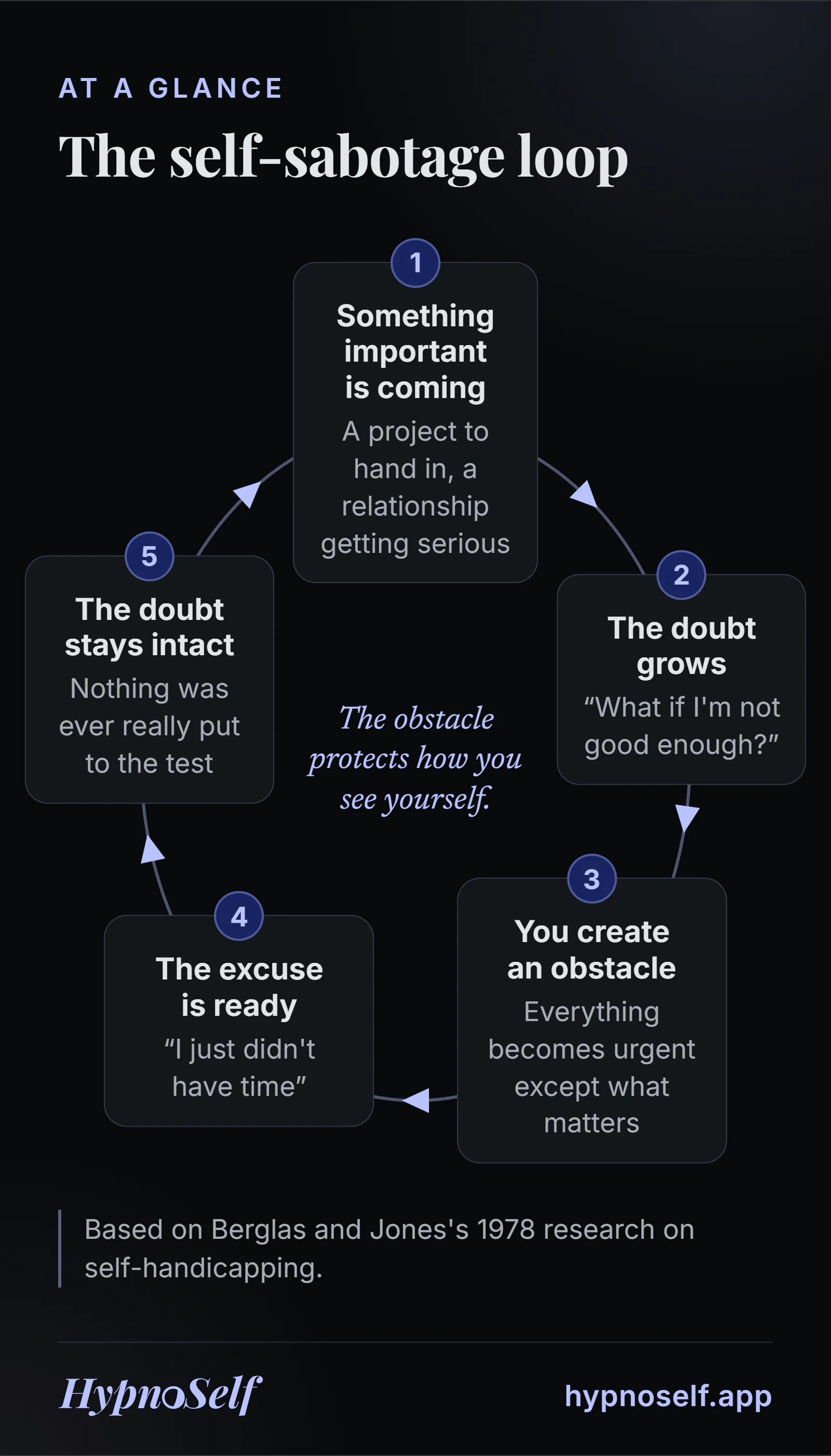
The everyday word covers several things, studied separately:
| What the word refers to | How it’s studied |
|---|---|
| Putting things off, preparing less | Self-handicapping |
| Damaging a relationship | Relationship self-sabotage |
| Failing just before the goal | In psychoanalysis, Freud’s “Those Wrecked by Success” (1916); later, the “fear of success” described by psychologist Matina Horner (1968) |
Find your belief and reprogram it.
- You describe what holds you back
- The app writes your affirmations
- You record them in your voice
- You listen at bedtime
7 days free, no commitment
Why do I self-sabotage?
Most often, to protect yourself: when you doubt yourself, a failure with an excuse hurts less than a failure where you gave it everything. Among school and college students, this reflex is linked mainly to fear of failure and lower self-esteem.
The largest review, by Schwinger and colleagues (2021), pooled 159 studies covering 81,630 students. The clearest links: fear of failure, lower self-esteem, poor organization and a tendency to worry. Students who mainly aim to learn and improve, on the other hand, sabotage themselves less. In practice: the more a failure seems to judge your worth, the more tempting the excuse. That’s why HypnoSelf’s sentences talk about progress (“I’m learning to…”).
Is it deliberate? Researchers haven’t settled it: you can stop studying too early without noticing. Some authors have written about this part of you that slips past your willpower.
Your willpower against an older program
In The Biology of Belief, Bruce Lipton asks what happens when your conscious wishes clash with your subconscious programs: “which ‘mind’ do you think will win out?” In his view, the programs win. What you hear in the first six years of life, like being told you’ll “never amount to anything,” gets recorded in a subconscious mind that overrides your willpower; he even writes of “self-sabotaging subconscious programming.” You decide to send your project on time; an old sentence about yourself decides otherwise. Sentences like that one are among the limiting beliefs that feed self-sabotage, and the app works with you to find yours. The conversation is free: it helps you trace your excuse back to your belief.
How do I stop self-sabotaging?
To stop self-sabotaging, start by spotting the scene that keeps coming back and the excuse it sets up for you. Behind the excuse there’s often a belief about yourself, like “I don’t deserve to succeed.” Then you gradually replace it with sentences your brain can believe, one small step at a time.
What one trial shows
Can you unlearn this reflex, and how long does it take? Zarshenas and colleagues (2019) randomly assigned 90 nursing students in Iran: half took six two-hour sessions of problem-solving training, the other half got nothing. Right afterward, the two groups showed no difference. A month later, the trained group was self-handicapping less, by a margin too clear to be chance. The takeaway: change comes after the effort, so give it a month before you judge.
Four steps to break the pattern
- Spot your scene: the night before a deadline, the third month of a relationship. Joe Dispenza puts awareness first: recognizing “when and how those programmed responses take over.”
- Name the excuse: “If this goes wrong, what’s my excuse going to be?”
- Look for the sentence about yourself it protects, like “my successes aren’t really mine” or “people always end up leaving me.”
- Make the step smaller and set a time: “I’m sending the project at 6 p.m., as it is.” Next time you slip, start again without punishing yourself.
The third step is the hardest to do on your own. The HypnoSelf conversation helps you find your belief, then the app writes sentences around that belief.
Self-sabotage in relationships, and its close cousins
When it comes to love, the same reflex, known as self-sabotage in relationships, damages the bond before it can hurt you. It’s the same calculation the students in the 1978 experiment made: if you bring about the end yourself, it doesn’t prove you can’t be loved. Lipton uses this very example: repeating that you’re lovable won’t hold if, as a child, you kept hearing you were worthless.
Sometimes, though, your doubts are right: if your partner puts you down or frightens you, pulling away is protecting yourself. Sabotage means looking for the flaw when everything is going well.
Two other forms have their own mechanisms: procrastination, when you keep putting things off, and perfectionism, when nothing is ever good enough to send.
When self-sabotage is a sign of something else
What looks like self-sabotage sometimes comes from something else: depression, ADHD or an unfair situation that no sentence will change. If everything is a struggle, not just when a goal gets close, talk to a doctor or a psychologist. HypnoSelf supports personal growth; it doesn’t replace help from a healthcare professional. If you’re going through a hard time, here’s who you can turn to.
Breaking the cycle of self-sabotage with HypnoSelf
Back to the relationship that’s going well. In the conversation, you explain that your relationships tend to end around the third month, often after a fight you started. The AI assistant asks what you feel just before the fight and digs down to the sentence your sabotage protects: “If people really get to know me, they end up leaving.”
From that sentence, the app writes 25 to 30 affirmations in your own words. “I deserve to be loved,” on its own, would say the exact opposite of what you feel: that’s Lipton’s own example, and the research on positive affirmations also calls for caution. Instead, your sentences describe a path:
- “I’m letting someone get to know me a little more each week.” Progress you can check: your brain can believe it.
- “Why do I feel safer and safer when someone cares about me?” A question: your brain looks for the times it was true instead of objecting. Noah St. John calls these questions “afformations.”
- “I’m allowing myself to believe someone can stay with me.” A bridge sentence, a gentler step, for as long as “I deserve to be loved” still meets resistance.
You record them in your own voice, over a background track, and listen at night as you fall asleep, with a timer that turns the sound off, or in the morning when you wake up: the moments that Joseph Murphy, Dispenza and the French pharmacist Émile Coué recommend for reaching the subconscious mind.
Start the conversation. The conversation, your affirmations and your recording are free, no credit card needed. Listening then requires a card: it starts a 7-day free trial, cancel anytime before it ends, then a subscription.
Frequently asked questions
Is self-sabotage a mental illness?
No. Self-sabotage isn’t a recognized diagnosis, and no self-sabotage syndrome or disorder appears in the DSM-5-TR or the ICD-11, the standard classifications of mental disorders. The term describes a common mechanism: as what you want gets closer, you do what pushes it away, like putting off a project or damaging a relationship.
Why do I keep self-sabotaging?
Most often to protect yourself: a failure with an excuse hurts less. Among school and college students, creating obstacles for yourself goes hand in hand with fear of failure and lower self-esteem. Bruce Lipton sees it as the effect of a belief recorded in the subconscious mind, one stronger than willpower.
How do you overcome self-sabotage?
Start by spotting the situation where it keeps happening, name the excuse it sets up for you, then look for the belief that excuse protects. To change that belief, Joseph Murphy and Émile Coué advise repeating new sentences every day, at night in bed and in the morning when you wake up.
Is self-sabotage a symptom of ADHD?
Self-sabotage isn’t one of the symptoms that define ADHD (attention-deficit/hyperactivity disorder), which center on inattention, hyperactivity and impulsivity. Still, trouble finishing a task can look like sabotage and come from ADHD. A doctor or psychologist trained in ADHD can tell the difference.
HypnoSelf is an app for affirmations written from your own words, recorded in your own voice and heard as you wake up and fall asleep. This page was written by the HypnoSelf team.