Which hypnosis app should you choose? 7 criteria to compare
By HypnoSelf · updated November 14, 2026
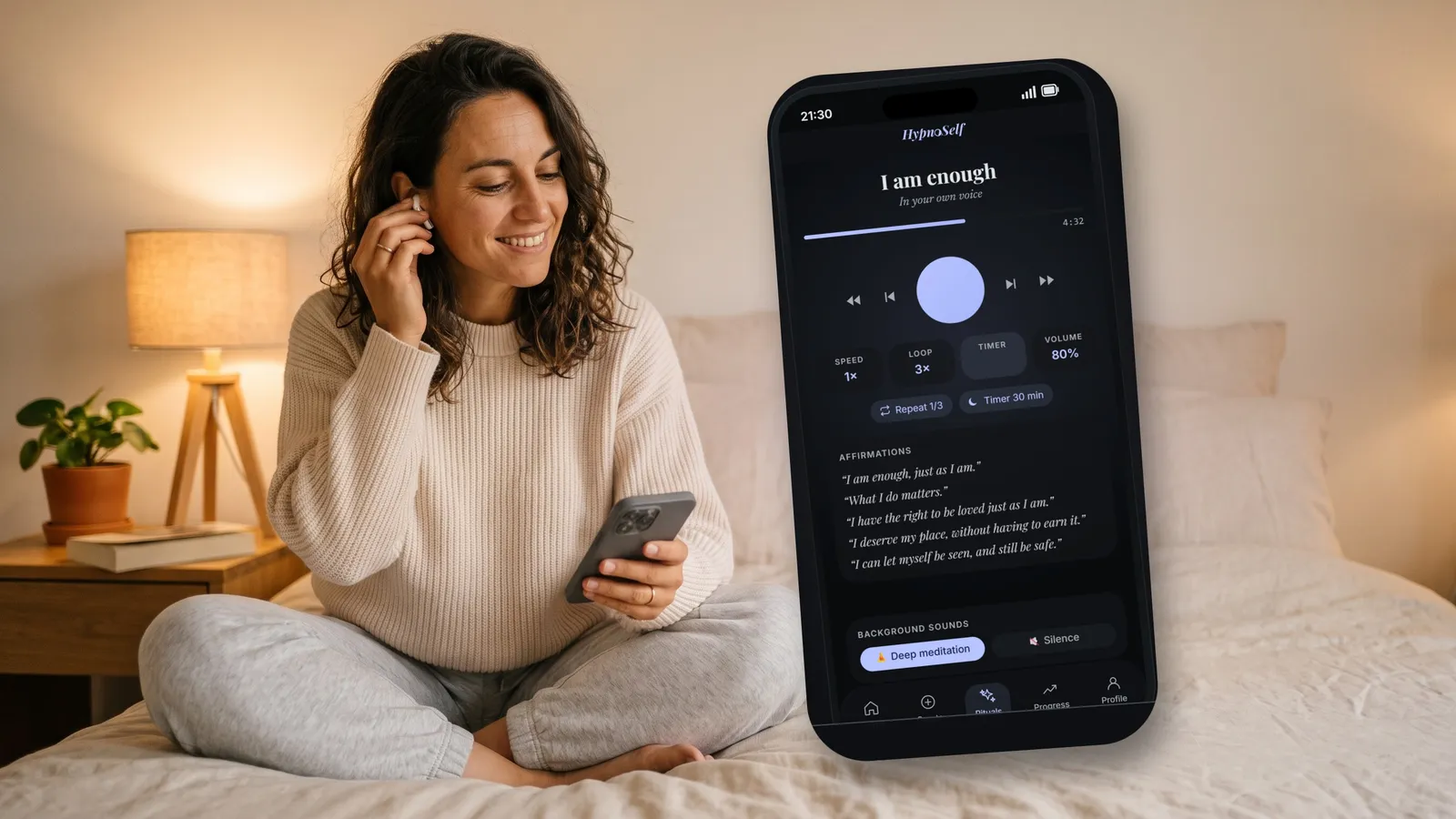
To choose a hypnosis app, seven criteria matter: the voice, the starting point, the sentences, the price after the trial, privacy, help sticking with it, and the evidence the app claims. They apply to any self-hypnosis app, and after each one, you’ll see how HypnoSelf, the affirmation app that publishes this page, handles it.
In short
- Before you pay for a hypnosis app, a simple test helps: listen to it for several nights during the trial, note the date of the first charge and find out how to cancel.
- Researchers examined 168 hypnosis apps: only 13 claimed evidence for their method, and 4 reported a clinical trial (Scheffrahn et al., 2025).
- HypnoSelf starts from your belief, found through a written conversation: the app turns it into sentences that you record in your own voice and listen to as you fall asleep or wake up.
| Key point | Value |
|---|---|
| Hypnosis apps examined | 168, out of 679 found (Scheffrahn, 2025) |
| Apps claiming evidence for their method | 13, or 7.7% |
| Health apps that sent data to other companies | 33 out of 36 (Huckvale, 2019) |
Contents
Is this page for you?
If you want to try hypnosis at home and you’ve opened several app listings without knowing which one to pick, this page is for you. The star ratings all look alike, and so do the promises. And you’re wondering what you’ll pay once the free trial ends.
The four types of hypnosis apps
Reading app store listings and the apps’ own websites in November 2026, we found four types of self-hypnosis apps.
| Type | How it works | Who’s speaking |
|---|---|---|
| Session library | You pick a topic and a length, then you listen | A practitioner, when the listing says so |
| Session that follows your answers | You answer during the session, and what comes next changes | Check the listing |
| AI-adapted session | Sessions advertised as tailored to your needs | A human or synthetic voice: check the listing |
| Affirmations in your own voice | You write or receive sentences, then record them | You |
YouTube also has free guided sessions. HypnoSelf belongs to the fourth type.
Find your belief and reprogram it.
- You describe what holds you back
- The app writes your affirmations
- You record them in your voice
- You listen at bedtime
7 days free, no commitment
How do you choose the best hypnosis app?
Our advice: start with what you want to listen to, then check six other points before you hand over your credit card. Two of them are easy to overlook: privacy, and the evidence the app claims for itself.
The voice: who’s talking to you?
A practitioner’s voice guides you from start to finish; your own voice means recording yourself. An experiment with students offers a clue: they remembered words better when they heard them again in their own voice, recorded a little earlier, than when someone else read them (Forrin and MacLeod, 2017). Émile Coué, the French pharmacist behind “Every day, in every respect, I am getting better and better,” told people to repeat it “moving your lips (that is indispensable).” And in You Are the Placebo, Joe Dispenza invites readers to record themselves reading his guided meditations.
In HypnoSelf, you record your sentences in your own voice. Your recorded voice often sounds strange at first, because it lacks the sound that reaches you through the bones of your skull when you speak. You get used to it within a few nights; at first, it helps to listen to it as if it were a stranger’s voice.
The starting point: a topic or your belief?
A session library has you pick a topic, like sleep or self-confidence: it names what you feel, not where it comes from. Two people who keep falling for someone who won’t commit may be telling themselves different things deep down. One: “I’m not worth staying for.” The other: “If I get attached, I’ll get hurt.” Two beliefs, so two different sentences to repeat. And according to cell biologist Bruce Lipton, an affirmation fails when it contradicts the messages programmed into your subconscious mind in childhood.
That’s why everything in HypnoSelf starts from your limiting belief, the sentence about yourself that you take as true and that holds you back. The conversation with an AI assistant digs down to it with you and helps you put it into words, as author Gregg Braden suggests: see how the conversation brings it to the surface.
You tell the AI your story
“With my partner, I can't bring myself to say how I feel. Deep down, I tell myself I'm not enough.”
The AI spots the belief holding you back
“I'm not enough”
It writes your affirmations, in your own words
“You are enough.”
“With my partner, I'm learning to say how I feel.”
The sentences: one-size-fits-all or written for you?
A recorded session says the same thing to everyone. A review published in 2026 pooled 122 studies of college students using mental health apps: apps that adapted to the person had a stronger effect on depression (Jabs et al., 2026). Given the choice, an app that starts from your situation is the better bet.
In HypnoSelf, the app writes 25 to 30 affirmations based on what you shared, in your own words, and you can edit them: you’ll find examples further down.
Price and commitment: what do you pay after the trial?
On the listings we read, “free” means one session, a trial week, a module or a few sentences, then a subscription or in-app purchases. Before you start, three things matter: what stays free without a card, the date and amount of the first charge, and how to stop.
In HypnoSelf, the Discovery plan is free, no card needed: the conversation, your affirmations and recording them in your own voice, which together make up your first ritual. A card is only needed to listen to it, and adding one starts a 7-day free trial, limited to 3 rituals. Nothing is charged during the trial, and three days before it ends, an email reminds you of the end date, the price that follows and how to stop.
After the trial, there are two plans: one billed every 3 months, and a yearly one that costs less per month. An email warns you 45 days before each renewal. You can cancel whenever you want, with no fees and no reason needed: in the app (Profile > Subscription) or on the Cancel my subscription page, even without signing in. You keep access until the end of the period you’ve paid for.
Privacy: who receives what you share?
In a hypnosis app, you talk about what’s weighing on you. In 2018, Huckvale and colleagues tracked the data sent out by 36 popular apps for depression and quitting smoking, in the United States and Australia: 33 passed data to other companies, and 28 sent some to Google, but only 12 of those disclosed it. Before you open up, it’s worth knowing who receives what you write.
At HypnoSelf, no one reads your conversations. During the conversation, Google’s AI analyzes your text to write your sentences, without receiving your email address, your account ID or your IP address: nothing links it to your account, and Google doesn’t use it to train its models. The conversation isn’t kept. Once you turn on encryption, the app encrypts your affirmations, your conversation summaries and your recordings with a key only you hold; the details are in our privacy policy.
Sticking with it: does the app help you come back?
A session can calm you that same evening; deeper change takes coming back to it again and again: in the words of Joseph Murphy, author of The Power of Your Subconscious Mind, “constructive, harmonious thoughts frequently repeated.” That’s also the hardest part, as a study further down shows, and an app can help.
In HypnoSelf, listening fits into bedtime or waking up, moments that are already part of your day, with a sleep timer that turns the sound off. Reminders, if you turn them on, and your listening streaks help you keep going, with a “Mental Anchor” badge after 21 days in a row. If it’s your thoughts that keep you awake, the page on the thoughts that keep you from sleeping shows how to set them down first.
The evidence: what does the app say about itself?
Many listings promise you’ll feel better; few say what that’s based on. In 2025, researchers who study hypnosis recorded what the makers of 168 apps claimed (Scheffrahn and colleagues): 13 claimed evidence for their method, and 4 reported a clinical trial. When an app cites a study, look for the reference, how many people were followed and for how long: that tells you what it’s worth.
HypnoSelf publishes the sources behind its method: for each choice, the studies and books that guided it.
Do hypnosis apps work?
With a practitioner, the effects of hypnosis have been measured: a review of 261 studies finds its strongest evidence for pain and for supporting patients during medical procedures (Rosendahl and colleagues, 2024). For apps, the research is more recent: it shows stress going down during sessions.
Tran and colleagues (2025) analyzed data collected by the maker of a popular consumer hypnosis app: before and after each session, 84,395 users rated their stress on a scale from 1 (lowest) to 10 (highest). During each of the first ten sessions, the score dropped by about a point and a half: noticeable relief in the moment. Another figure worth knowing when you choose: fewer than 1 user in 20 was still rating their stress by the tenth session. So a session can calm you tonight; to go further, what matters most is coming back to it.
And HypnoSelf? It’s still young and has no clinical trial to its name, like almost every app examined above. Its design draws on what has been studied (your own voice, sentences written for you) and on what Coué and Murphy advised: repeat every day, at bedtime and when you wake up. The feedback we’ve received since launch has been very positive, and the best way to find out whether it makes a difference for you is to try it: the Discovery plan is free, no credit card needed.
The test to run before you pay
Whatever the app:
- Listen to it for several nights during the trial, in the place where you’ll actually use it.
- Note the date of the first charge and the cost over a full year.
- Find out how to cancel and who receives your data.
With HypnoSelf, this test starts without a card: find your belief, get your sentences and record them.
Other questions depend on what you’re after: self-hypnosis for sleep, hypnosis for confidence, whether self-hypnosis is dangerous, hypnosis vs. meditation.
When another app will suit you better
A session library will suit you better if you want a voice to guide you tonight, without writing or recording anything. If you’d rather not share anything with an AI, choose an app that doesn’t use one. HypnoSelf is for people aged 16 or over.
Whatever the app, never listen to it while driving. HypnoSelf supports the work you do on yourself; it doesn’t replace help from a health professional. If you’re going through a hard time, here’s who you can turn to.
HypnoSelf: an app built around your belief
On the first night, you open the app in your browser, on iPhone or Android, with nothing to download, and you describe what’s weighing on you. For example: “Every time I start saving, the car breaks down or a bill shows up, and I’m back to zero.” The conversation helps you find the belief hiding behind it, maybe “money always slips through my fingers.”
The app turns it into your affirmations. Some describe gradual progress, like “Little by little, I’m learning to keep what I earn”: your brain accepts progress more easily than the exact opposite of what it feels. Others are questions, like “Why do I feel more and more at ease with money?” Author Noah St. John calls these “afformations”: your mind looks for an answer instead of pushing back.
You record them in your own voice, over background sounds, and listen as you fall asleep or wake up: according to Joseph Murphy, these are the best times to impress an idea on your subconscious mind. In other words, you’re listening to your own suggestions, relaxed, on the edge of sleep, with no guided session.
Start the conversation. The conversation, your affirmations and your recording are free, no credit card needed. Listening then requires a card: it starts a 7-day free trial, cancel anytime before it ends, then a subscription.
Frequently asked questions
Is there an app for self-hypnosis?
Yes, several kinds of apps exist for self-hypnosis: guided sessions, prerecorded or adapted by AI, and affirmation apps where you record your own sentences, like HypnoSelf. The right choice mostly depends on whose voice you’ll hear, whether the sentences are general or written for you, and what the app costs over a year.
What is the best free hypnosis app?
No single free hypnosis app is best for everyone: the best one is the one you’ll actually listen to. The app listings we read in November 2026 offer limited free access, then ask for a subscription or purchases. In HypnoSelf, the conversation, your sentences and recording them are free, no card needed; listening starts a 7-day trial.
When should you use hypnosis?
In sessions with a practitioner, hypnosis has its strongest evidence for pain and for supporting patients during medical procedures, according to an overview of 261 studies (Rosendahl, 2024). On your own, at home, people mostly use it to relax before sleep or to work on a belief. For a health problem, talk to a doctor first.
How long does it take for hypnosis to work?
A session can calm you in the moment: among 84,395 users of a hypnosis app, stress rated from 1 to 10 dropped by about a point and a half in each of the first ten sessions (Tran, 2025). For lasting change, think in weeks of regular practice: Coué had people repeat his “better and better” formula every morning and evening.
HypnoSelf is an app for affirmations written from your own words, recorded in your own voice and heard as you wake up and fall asleep. This page was written by the HypnoSelf team.