Why you hate the sound of your voice, and how to get used to it
By HypnoSelf · updated November 14, 2026
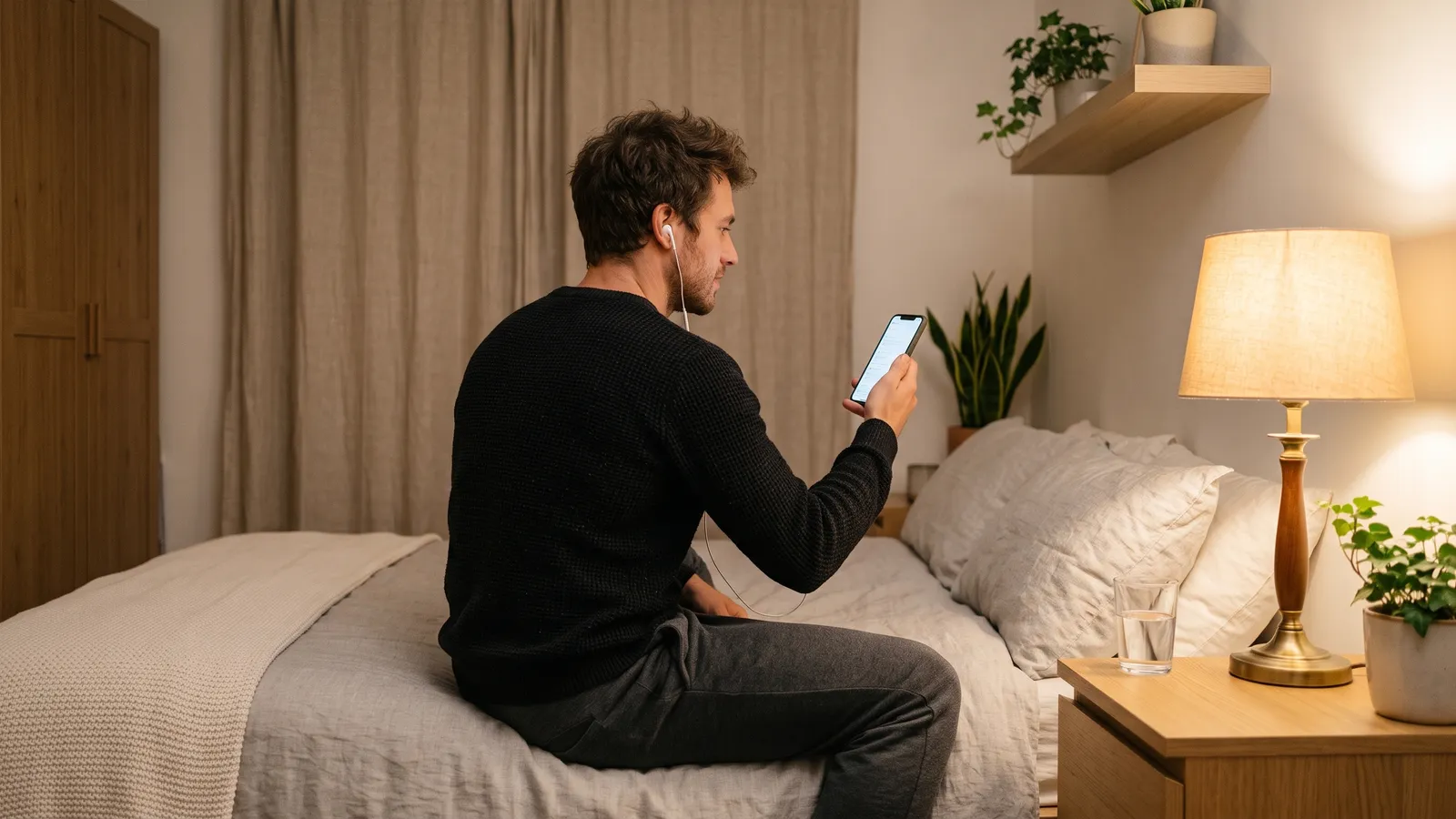
“I hate my voice”: that’s often your first thought when you hear yourself in a voice message. When you talk, your voice reaches you through the air and the bones of your skull; a recording keeps only the air, and that unfamiliar sound throws you. Listening back gets you used to it, which helps if you want to record positive affirmations.
In short
- Your recorded voice lacks the part that reaches you through your skull: in one experiment, 43 adults told their voice apart from someone else’s more easily when the voices reached them through the bones rather than the air (Orepić and colleagues, 2023).
- 80 men and women rated how attractive recorded voices were, without being told their own was among them: on average, they rated their own voice as more attractive than the other participants did (Hughes and Harrison, 2013).
- Among 41 people who dread how others see them, listening back to a recording of their own speech as if the voice were a stranger’s improved how they judged their voice more than listening with no instruction (Nilsson and Lundh, 2016).
| Key point | Value |
|---|---|
| Why your recorded voice surprises you | It’s missing what you hear through your bones when you talk |
| Your voice, rated blind | On average, more attractive to you than to others (80 people, 2013) |
| To get used to it | Record yourself somewhere quiet, talk as usual, listen back as if to a stranger, repeat |
| In HypnoSelf | Your affirmations recorded in your own voice, heard at bedtime or when you wake up |
Contents
Why do you hate the sound of your voice on recordings?
Because you’ve never heard it that way. When you talk, the sound reaches you through the air, to your ears, and through the bones of your skull. A microphone only picks up the air. The people close to you hear that version every day; you’re discovering a voice that’s missing a familiar part.
Anthony knows that surprise well. He never sends voice messages: he records one, plays it back, winces (“I sound like a teenager with a cold”) and types a text instead. One evening, he opens HypnoSelf to record the affirmations the app wrote for his belief, “nobody cares what I have to say.” He reads the first sentence, plays it back, winces and closes the app.
Researchers have measured what difference the sound traveling through your bones makes (Orepić and colleagues, 2023). Adults (16 in one experiment, 43 in another) listened to voices that blended their own with a stranger’s, and said whose voice they heard. When those voices came through headphones that carry sound through the bones, rather than through the air, they were better at picking out their own. According to the authors, the lack of this bone-conducted sound is one of the main reasons a recorded voice sounds strange.
For Anthony, that’s what his voice message is missing: the part that helps him recognize his voice as his own.
Is it your voice you hate, or the surprise?
Often, it’s the surprise. The moment you hear yourself on a recording has had a name in psychology since the 1960s: “voice confrontation” (Holzman, Berger and Rousey, 1967). And in a more recent study, people who rated voices without being told their own was among them tended to like theirs.
That study had 80 men and women rate the attractiveness of recordings of people counting from 1 to 10, three of them in their own voice (Hughes and Harrison, 2013). On average, they rated their own voice as more attractive than the other participants did, and more attractive than the other voices. The researchers see it as a sign that people judge themselves favorably, and believe, without having measured it, that most participants didn’t recognize their own voice.
For Anthony, wincing at his voice message probably says little about his voice; mostly, it says he isn’t used to hearing it that way. His friends hear that “teenager with a cold” every week: to them, it’s just Anthony.
Getting used to it is worth it: you remember what you hear in your own voice better than in someone else’s, as explained in the guide on why it helps to hear your own voice.
Find your belief and reprogram it.
- You describe what holds you back
- The app writes your affirmations
- You record them in your voice
- You listen at bedtime
7 days free, no commitment
How do you get used to your recorded voice?
In four steps: record yourself somewhere quiet, talk the way you do every day, listen back as if it were someone else talking, then repeat for a few days in a row. You usually get used to your recorded voice quickly, simply by hearing it often. Anthony follows these steps for his affirmations.
1. Record yourself somewhere quiet, in a small room
Pick a furnished room and close the door: curtains and a bed soak up echo. Hold your phone about eight inches away, a little to the side of your mouth, so your breath doesn’t hit the mic. That way, you take out the part of the surprise that has nothing to do with your voice.
Anthony had recorded himself in his tiled kitchen, with his phone sitting on the table, far from him. He tries again in his bedroom, phone close to his face.
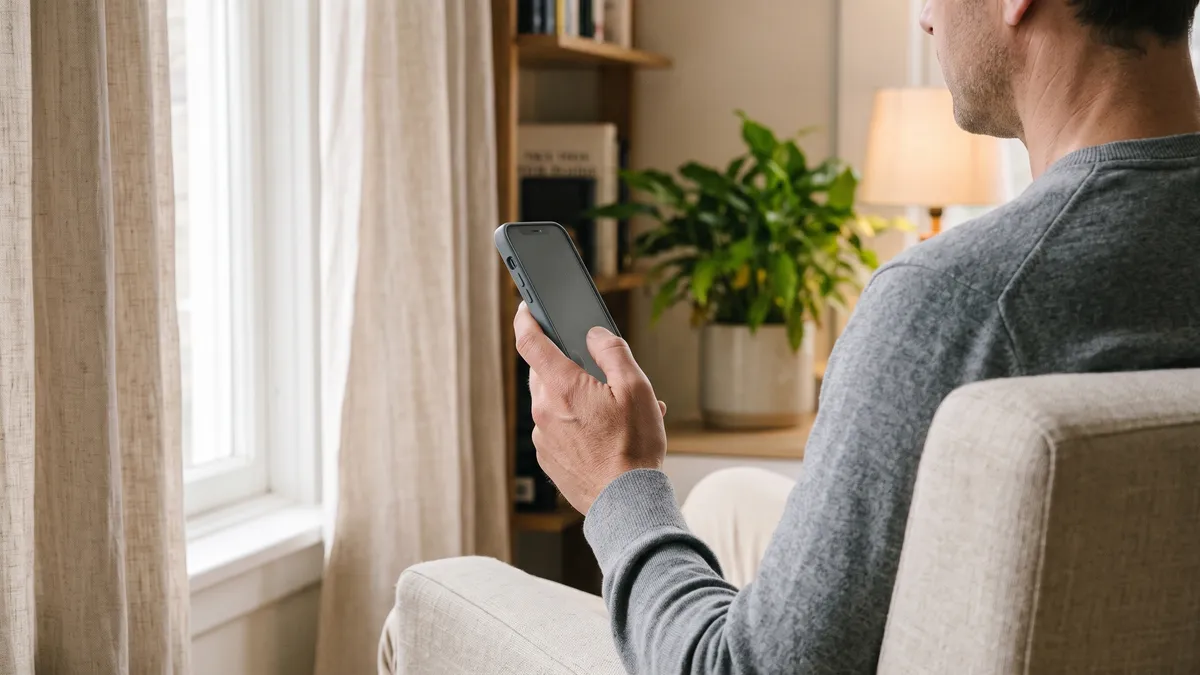
2. Talk the way you’d talk to a friend
Read your sentences calmly, in your usual voice, without trying to sound deeper: a forced voice will sound even less like you when you play it back.
The first time, Anthony had put on a newscaster voice to sound serious. This time, he reads as if he were telling his brother about his day: his voice still surprises him, but he recognizes the way he talks.
3. Listen back as if it were someone else talking
Before you press play, give yourself one instruction: you’re listening to a stranger’s voice, not hunting for flaws. Then rate your discomfort from 0 (none, like listening to a friend) to 10 (you hit stop after two seconds).
This instruction was tested with 41 socially anxious people, who dread the way others see them (Nilsson and Lundh, 2016). Each gave a speech, listened back to the recording, then rated their voice; half of them, chosen at random, were first asked to imagine they were listening to a stranger. In that half, their opinion of their own voice improved more clearly than in the half that listened with no instruction, and the effect still held at the second speech. It’s a small study, with a single session.
Anthony tries it: when he imagines a coworker reading a text aloud, his “teenager with a cold” mostly sounds calm, and his discomfort, an 8 on the first listen, drops to a 6.
4. Listen back several days in a row
One listen leaves you stuck on the surprise; several wear it down. Listen to yourself every day, at the same time.
Anthony listens to his sentences every night at bedtime. After a week, his discomfort is down to 3 and he mostly hears what the sentences say. The following Saturday, he sends his brother his first voice message in months. If you don’t have any sentences to record yet, the app writes them from your belief.
What if it's your voice itself that bothers you?
If, after a few weeks, what bothers you is your voice itself rather than the surprise, a speech-language pathologist (a speech therapist) can help you work on articulation and tone, and a voice teacher can help with your breathing. And if your voice has changed, sounding hoarse or tired for several weeks, see a doctor about it.
HypnoSelf supports personal growth; it doesn’t replace help from a healthcare professional. If you’re going through a hard time, here’s who you can turn to.
Recording your affirmations in your own voice with HypnoSelf
In HypnoSelf’s conversation, Anthony first typed out a scene for the AI assistant: at a dinner with friends, he starts telling a story, someone cuts him off, and he mutters, “Never mind, forget it.” The assistant asked him one question at a time, until it reached his belief, which he confirmed. To start from your own scene, describe it to the app. The app then wrote 28 sentences from his words. In “Little by little, I dare to finish my stories,” the “little by little” means he doesn’t have to believe it all at once; “Anthony, you have every right to take up space” talks to him the way a friend would.
That first evening, in his kitchen, the recording screen had told him to settle in somewhere quiet and to smile as he spoke, then scrolled through his sentences one at a time. On his first playback, the app showed him: “Surprised by how your voice sounds? That’s normal. Listen to it as if it were someone else’s.” The next day, in his bedroom, a sentence read too fast made him tap “Start again,” and he saved the next take.
Now he listens to his recording every night as he falls asleep, over background sounds, and a sleep timer stops playback. According to author Joseph Murphy, the moments just before sleep and right after waking are the best time to impress an idea on your subconscious mind.
The goal: for Anthony to hear his sentences rather than his voice, and, at the next dinner, to finish his story.
Start the conversation. The conversation, your affirmations and your recording are free, no credit card needed. Listening then requires a card: it starts a 7-day free trial, cancel anytime before it ends, then a subscription.
Frequently asked questions
Why do I hate my voice?
Disliking your own voice is very common, especially on a recording. When you talk, you hear it through the air and through the bones of your skull; a recording keeps only the air, so it sounds different from the voice you know. Listening back several days in a row helps you get used to it.
Why do I hate my voice when others like it?
Because they don’t hear the voice you hear. A good recording made somewhere quiet comes close to what others hear every day, and to them, it’s just your voice. The one you hear as you talk is just as real: it blends sound from the air with sound traveling through your skull, and nobody else hears it that way.
Why do we hate our own voice so much?
Mostly because, on a recording, it sounds different from the voice you hear as you talk. Yet when people rate voices blind, they tend to like their own: in a 2013 study, 80 men and women who hadn’t been told their voice was among the ones they were rating found it, on average, more attractive than the other participants did.
How can I learn to accept my recorded voice?
By recording yourself somewhere quiet, in your everyday voice, then listening back several days in a row. Listening to it as if it were a stranger’s helps too: in a study of 41 socially anxious people, being asked to do just that improved how they judged their own voice more than listening back with no instruction.
HypnoSelf is an app for affirmations written from your own words, recorded in your own voice and heard as you wake up and fall asleep. This page was written by the HypnoSelf team.